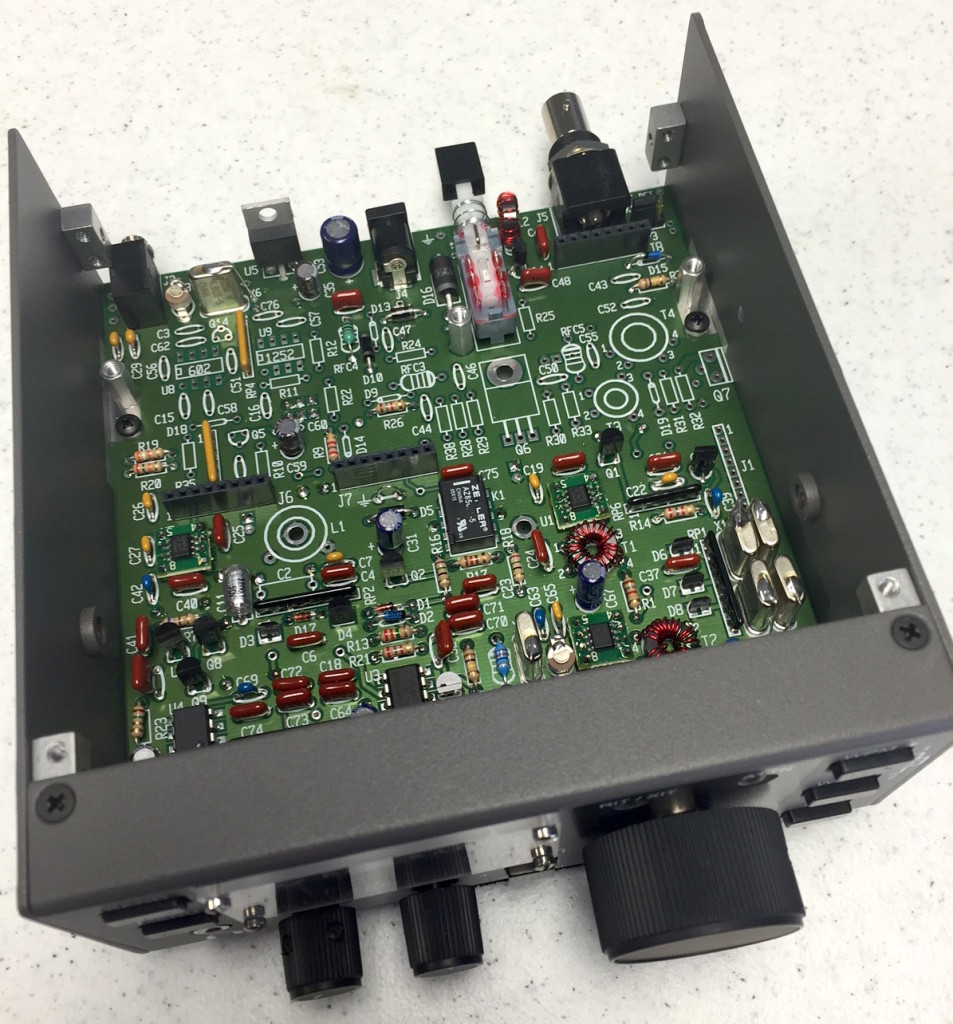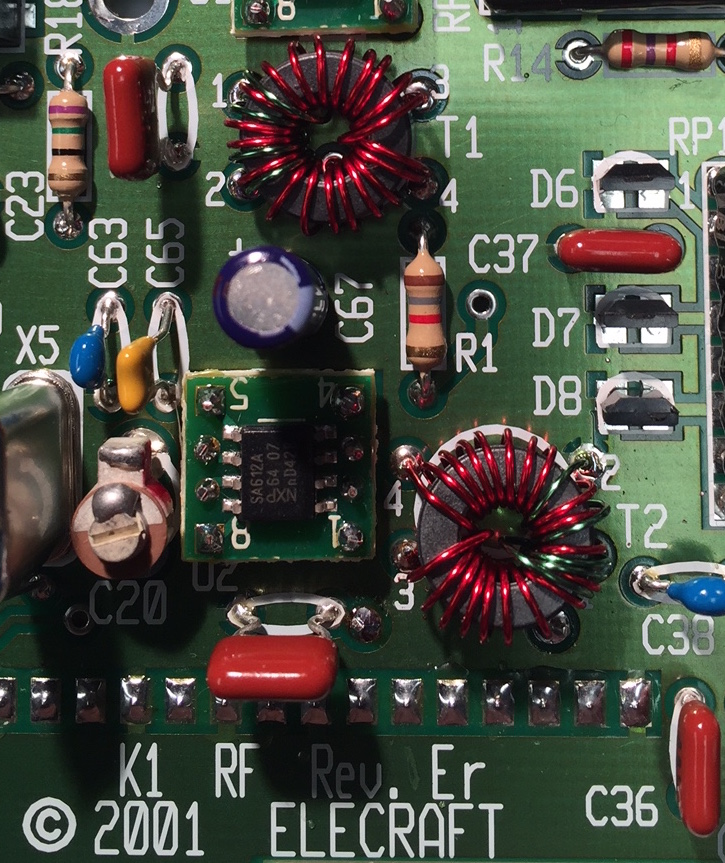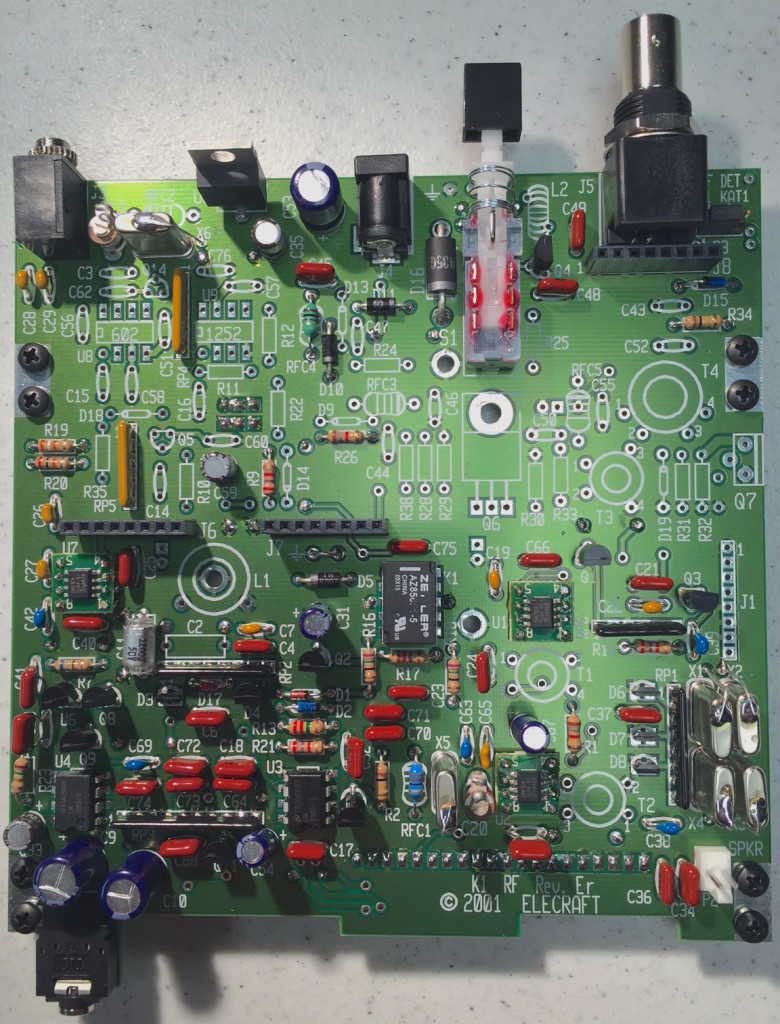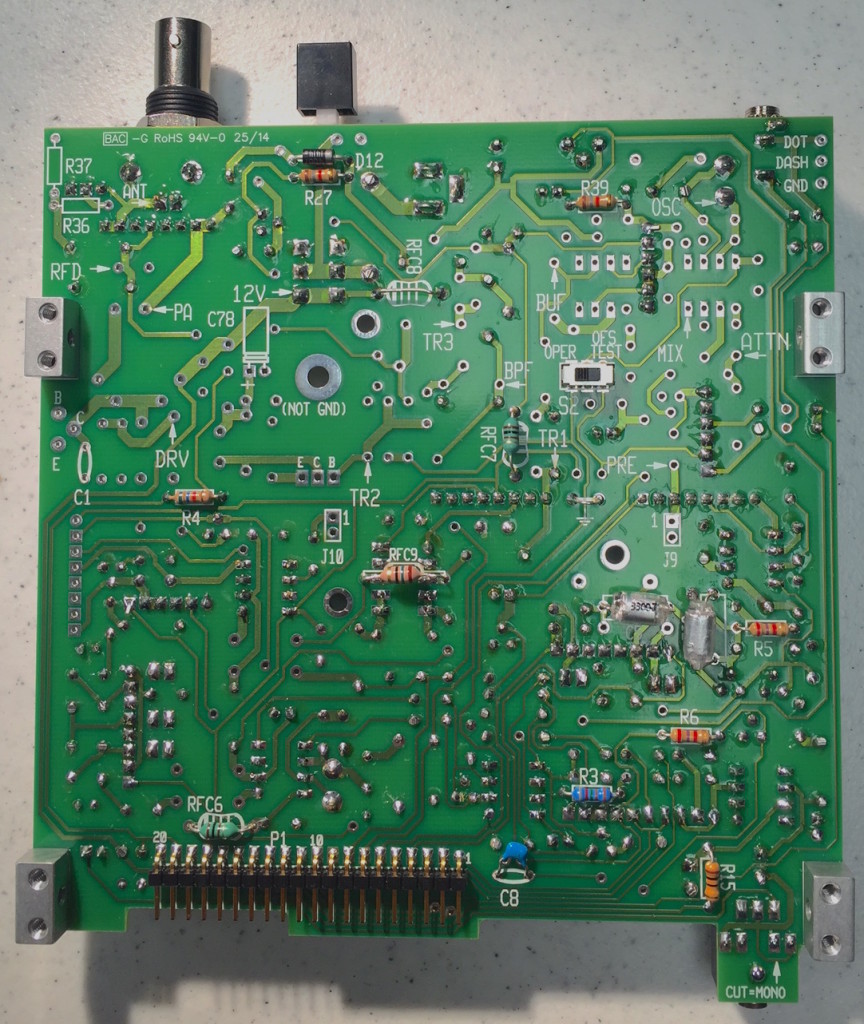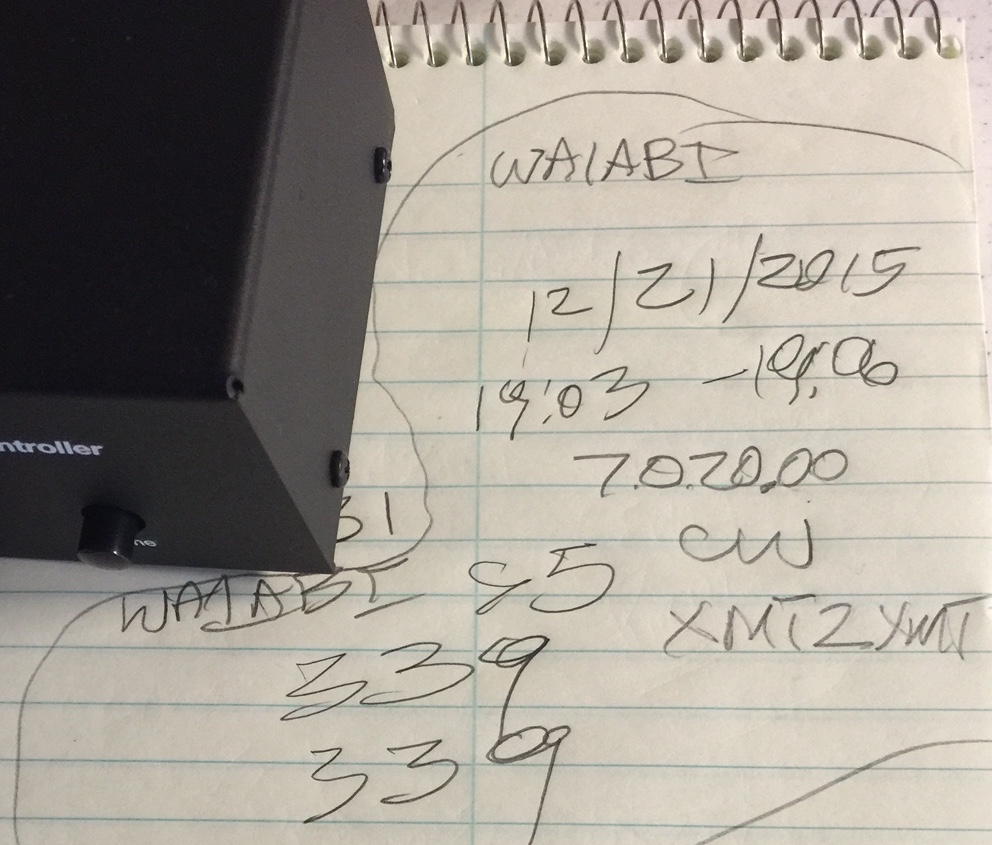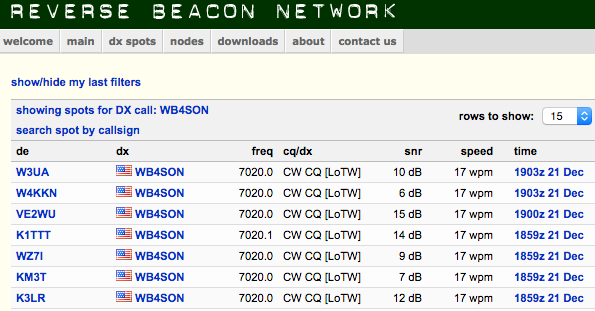
K1 RF Board Assembly Underway

It’s been about 5 days since I did any work on the K1.  This time of year it’s important to keep the family happy, and that means lots and lots of Christmas decorations.  I hate the thought of landfilling the many sets of lights we use each year, so I insist on repairing them.  This year I replaced several hundred lamps, which occupied my time for several days.  But the lights are up, the house is festive, and my time is my own again.

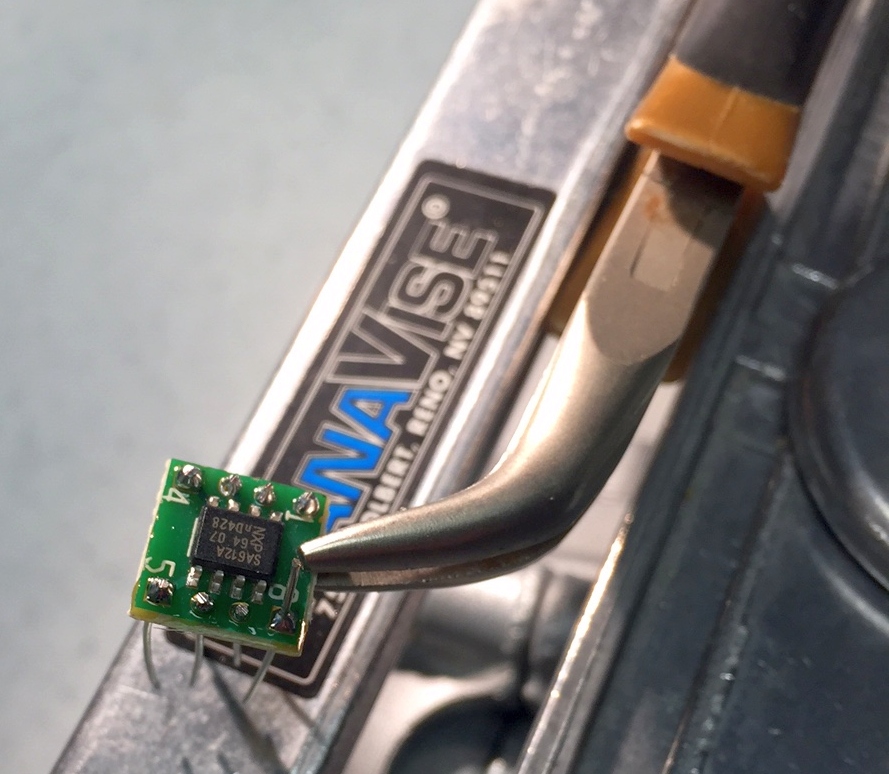
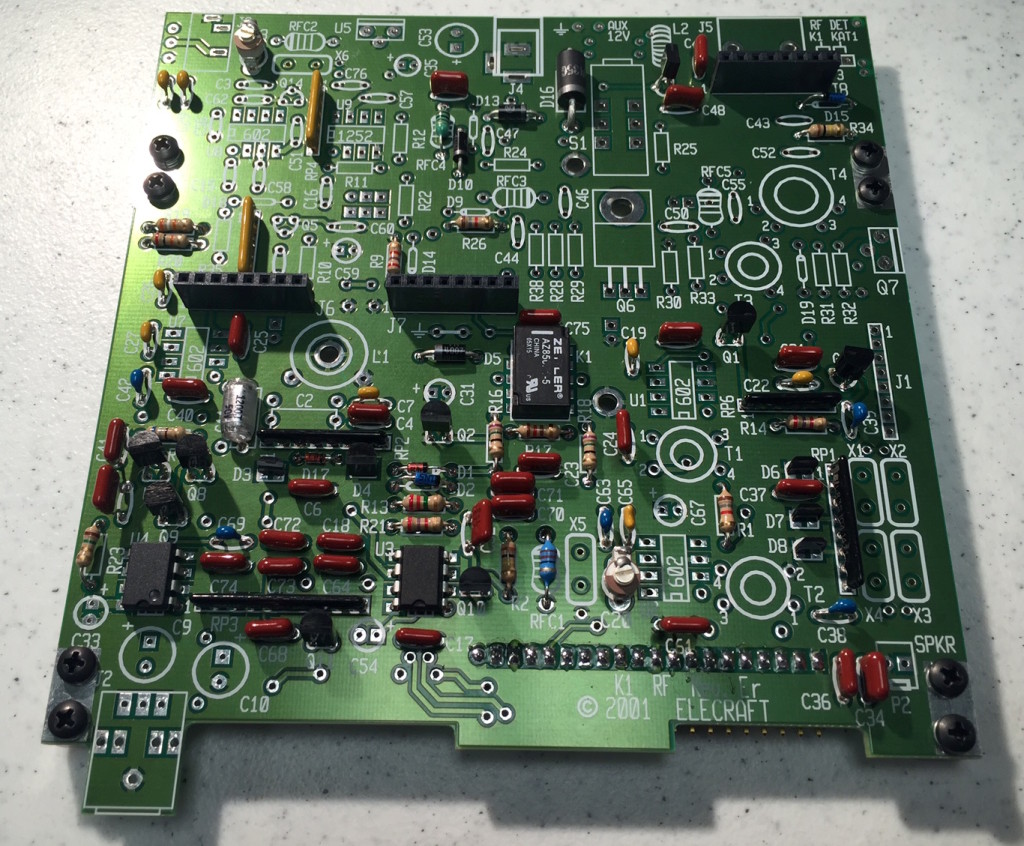
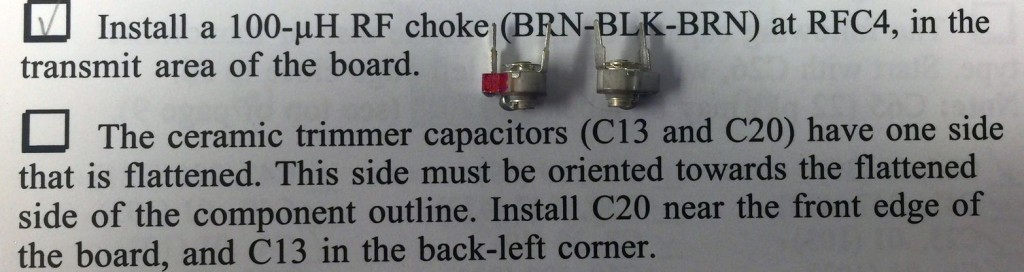
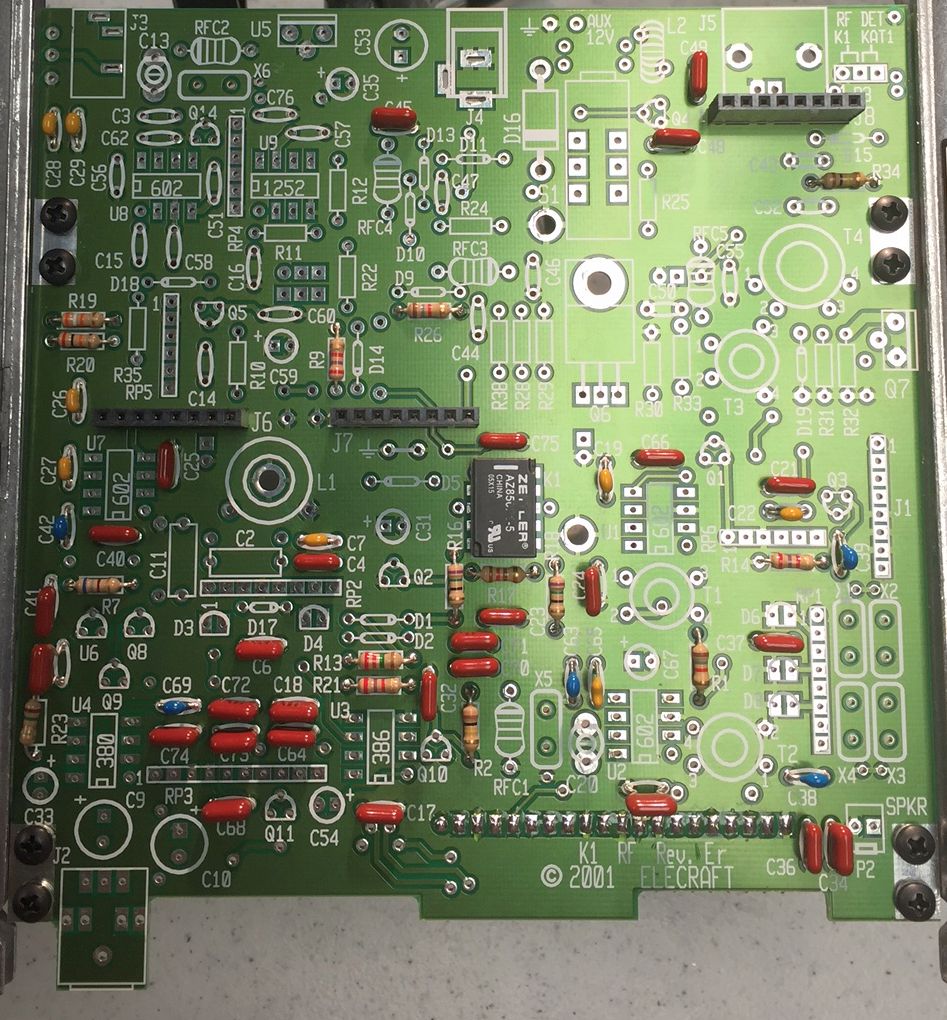
Today I began the assembly of the K1 RF board.  I estimate that this one card is about half the total assembly effort — lots of parts.  But I surprised myself today by spending about 70 minutes to install 40 components; under 2 min/part.  When I did the inventory of the RF board parts, the tiny caps were a devil to read, so after accounting for each one, I put them into individually labeled bags.  I still verify them, but at least I don’t have to look through dozens of identical looking caps to find the one I need.  And I discovered that the resistors, which had been sequenced on tape as if for automatic assembly, were in the order that they are installed.

RF Begin

Posted in From the OM, Gear, Projects | Leave a comment

SCS DR-7400 Modem and the Icom IC-9100

I haven’t been able to get my Icom IC-9100 and SCS DR-7400 P4 modem to play nicely together.  No matter what I’ve tried, the modulation level was too high, showing substantial ALC action, which would lead to a distorted transmit signal.

Some investigation last week indicated that the DATA2 connector on the back of the IC-9100 expects a VERY low level of audio, something on the order of 30 mvpp.  The minimum audio output level on my DR-7400 is about 41 mvpp (max is about 3200 mvpp).

The solution will be to make a small adapter cable (Male miniDIN-6 to Female miniDIN-6 — the same connectors used on a PS2 keyboard extension cable) with a voltage attenuator built in.  Something on the order of a 470 ohm resistor across the IC-9100 audio input line and ground, with a 3300 ohm resistor in series to the audio out line of the DR-7400.   Combined with the 1K output impedance of the DR-7400, that will produce a 10-1 voltage division.  So 300 mvpp from the DR-7400 (one order of magnitude above the minimum and one order of magnitude above the maximum), will produce about 30 mvpp at the IC-9100 input (a range of 3 mvpp to 300 mvpp).

Posted in Digital Mode, From the OM, Gear | 4 Comments

A Surprise From the ARRL

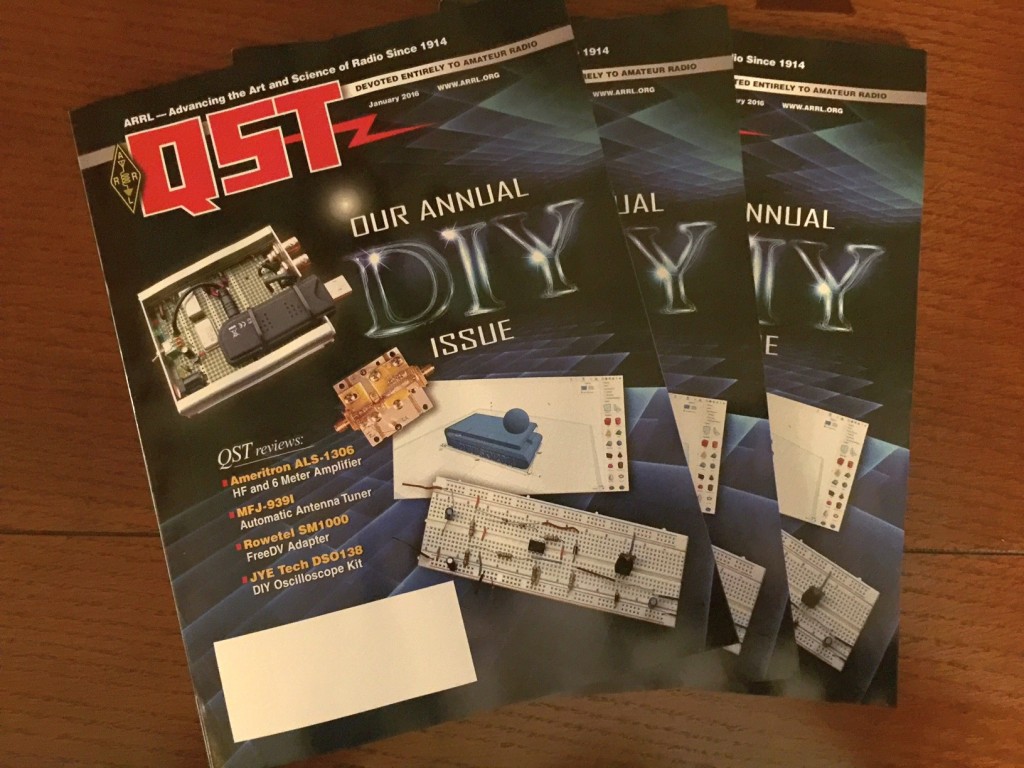
A large envelope from the ARRL arrived this weekend.  It look suspiciously like the kind they send out awards for states or sections in various contests, but I didn’t recall submitting a log recently.  I was pleasantly surprised to find a nice letter and a certificate inside:

ARRL Author's Certificate

Posted in ECOMM, Education, Public Service | Leave a comment

K1 Front Panel Completed

The Front Panel assembly had 75 components and took 265 minutes of assembly and verification time.  That works out to 3.5 minutes per component and 4.4 hours.

At this point, I feel that I’m about halfway finished with the build based on the number of components installed so far.  If so, I’m at 8.7 hours of assembly time, which would double to about 17.5 hours.  Add in 3.5 hours of inventory time, and it looks like it will take 21 hours to assemble.  I have no idea how much time the testing/alignment will take, but 24 hours is seeming like a pretty reasonable estimate for a completed K1.

By the way, the K1 front panel is 5″ across, and 2.25″ tall — we are talking a tiny QRP rig!

FP Front Done

FP Top DoneFP Bottom Done

Posted in From the OM, Gear, Projects, QRP | Leave a comment

December Triple Play

I try to make at least one needed DX or stateside contact every month.  Some months are easier than others, mostly depending on how busy I am with other things.  Recognizing that I hadn’t made any December QSOs yet, and figuring I should get them in the log while I had a chance, I turned on the radio and started listening around.

It didn’t take long to find a CW station on 15m in South Cook Island, a new band-point for me.  I then went looking again, and found a booming station in the Turks and Caicos Islands on 17m SSB.  I then popped down to 20m and found a RTTY station from Haiti and worked him.  Without even knowing it, I had just worked a Triple Play (all three modes: CW/Voice/Digital).TriplePlayDec

This despite declining solar activity (at least absorption and geomagnetic activity is low)SolarDataDec

Posted in Digital Mode, DX, Operating, Propagation | Leave a comment

K1 Front Panel Board Started

I continued to test and evaluate the audio level issue with the SCS P4 Dragon Modem today, so I didn’t have much time for assembly.  But I did get a start on the K1 Front Panel Board.  14 components (front and back) in an hour.

K1 FP Start

Posted in Gear, Projects | Leave a comment

Pactor Modem Arrives

I had ordered a P4 Dragon Pactor modem which finally arrived a few days ago.  My intent was to hook it up to my IC-9100 so I can use either Pactor III on HF (P4 is not legal in the US even though it uses no more bandwidth than a SSB signal) or Packet on VHF.  Things are sort of OK, it hears well, but the transmit audio level is causing full ALC action, which is not good for a digital mode.  Even though the IC-9100 input spec is full output at 100mv p-p, and the P4 modem is adjustable from 1 to 140 mv p-p, it is still over driving the radio.

Mostly because I was checking the modulation level, I started a session with VE1Yz on 80 meters last night with my power dialed all the way to “zero”.  I was shocked when the connection was completed and data transfer at 4400 bps.  I measured the power output with my QRP meter and found it to be 50 milliwatts.  That’s pretty impressive performance for a high speed digital mode on a noisy 80 meter band.

P4 Dragon

Posted in Digital Mode, From the OM, Gear | Leave a comment

K1 Filter Board Completed

I’d say this is about 1/6 of the work (2/6 for the Front Panel, and 3/6 for the RF board remaining).  It took a total of 255 minutes to complete the installation of 64 component, or about 4 minutes per part (that would put the total assembly time for the K1 at about 25 hours).  That includes all of the final assembly tests (resistance, shorts, opens, correct placement, etc.) as well as quite a bit of time spent with the toroids (especially the incorrect diameter parts).

K1 FB Done

Posted in From the OM, Gear, Projects | Leave a comment

November DX Wrapup

I’m definitely in the slow-crawl mode, but I did pick up a pair of all-time new ones that confirmed quickly.  With 5 QSLs in hand, that brings my confirmed total to 244, and 1155 band-points.

LotW Results Nov 30 2015

Posted in DX | Leave a comment

K1 Assembly Burp #1

Things were going swimmingly with the K1 Filter Board assembly, still at a rate of 1 component per 3 minutes (I follow a 7-step process:  check value, check value, install, check value, solder, check value, check solder).  Then I hit a snag…

When you order the K1, you select which two bands you would like.  I picked 30m and 20m, two of my favorite CW bands.  I had done a careful inventory of all parts and found them all there.  However, the Bill of Material didn’t specify the toroid size, just the color.  I had two T50-6 cores with the 30m kit, and two T37-6 cores with the 20m kit.

When I got to the assembly instructions for the 30m L9 and L10 toroids, I found they should have been on a T37-6 core too — the cores I had were a bit larger.  The desired inductance (1 uH) was known, specified at 18 turns on a T37-6 core.  I verified that, then reran the calculations using a T50-6 core, and found it would require 16 turns to maintain the 1 uH value.  I then called Richard at Elecraft and asked his opinion — “no problem, use the T50 cores and just take a turn off”, was his advice — so 17 Turns it will be.

The only down-side I see is that the T50 cores, being a bit larger, put L9/L10 a bit closer, and it is possible there might be an issue with the automatic antenna tuner since the toroid stands tall.  However it is exactly the same height as the slug-tuned inductors in their metal cans, so surely the board spacing will be adequate to clear both.  Besides, at the moment I have no plan on using the internal tunger since I have several external ones.

Needless to say, I verified the diameter of every other toroid in the kit.  Fortunately they appear to be correct.

L9L10

Posted in From the OM, Gear, Projects | Leave a comment