I’m obsessing I know but this is close…
V44KAI from Saint Kitts became confirmation 99 in LotW when it came in just before midnight.
ONE TO GO !!!
I’m obsessing I know but this is close…
V44KAI from Saint Kitts became confirmation 99 in LotW when it came in just before midnight.
ONE TO GO !!!
At lunch today I was surprised to find my slow climb to DXCC was a little closer with 98 confirmed countries in LotW. My logbook is a bit more optimistic, of course, since I show 142 counties worked. Of the 44 remaining unconfirmed countries, over half of them have been worked on two or more bands (9 on 2 bands, 7 on 3 bands, 3 on 4 bands, 3 on 5 bands, and 1 on 7 bands). One would hope that two more of those might find their way into LotW over the next few weeks.
Meanwhile, I continue to add new countries, and that is really where the fun is at, working a “New One”.
Sometime this morning I ticked over 100 confirmed countries with the addition of Cuba, Martinique and Malpelo Island on LotW, plus Angola on eQSL — bringing my total confirmed countries to 103. Unfortunately that’s a mix of LotW and eQSL. Currently I have 91 confirmed on LotW and 79 confirmed on eQSL out of a total of 136 countries worked in my logbook.
The goal is to get to DXCC on LotW and eDX100 on eQSL, of course, so that means 9 more in LotW and 21 more in eQSL. As always, obtaining the confirmations seem to be harder than making the initial contacts. But if I roll the clock back to late December 2011, I had a total of 53 confirmed in eQSL, and even fewer in LotW (somewhere in the 40’s). So, not bad, all things considered.
The Malpelo Island confirmation was somewhat of a shock as the confirmation was for HK1N, who is a Colombian station. I didn’t even realize at the time that he was one of the early people during the setup of HK0NA (Malpelo 2012 DXpetidion). But the setup guys, prior to the official start the next day (Feb 10) were using their own call. Still the HK0NA QSL will be a nice one to obtain as I worked them on 8 bands.
So I got back on the air exactly a year ago today after my decade break from Ham Radio (a 2 meter SSB QSO with N2ULF). What a journey this past year has been. QRP with a FT817, to an IC-9100, and onto a Elecraft K3/KPA500. Obtaining WAS on JT65, WAC, participating in several contests including Field Day, and getting my code speed back up to 35 WPM were some of the highlights.
As if I needed more, I just had a 40 meter CW QSO with Felix Reiss, DP1POL, who is currently stationed on the Ekstroem Ice Shelf, Antarctica. Maybe ordinary to lots of hams, but far beyond my standards of “normal”.
So today I boxed up my Yaesu FT-817ND and LDG Z-817 tuner. They are off to their new home in TX. That little QRP rig is responsible in a major way for rekindling my interest in Ham Radio. Hopefully it will be providing as much pleasure to someone else soon.
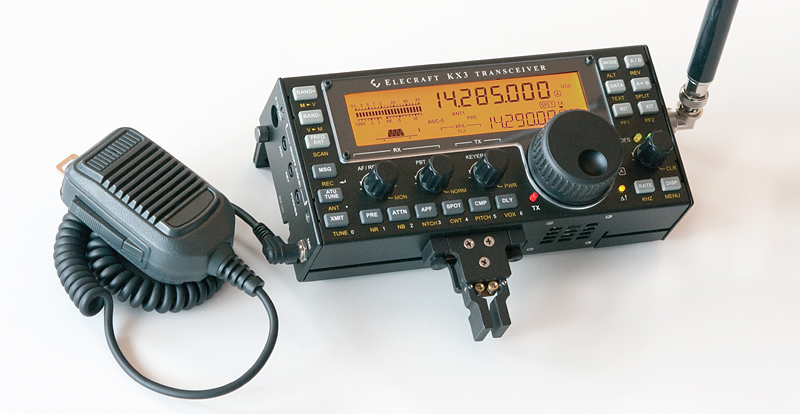
As I explained about a year ago, I’ve always had an interest in QRP rigs. That interest continues today — so why get rid of the 817? Well Elecraft is a company that has captured my heart, and they are going to capture some of my money when they start shipping the KX3. So the 817 is making room in the shack for its newer big brother.
I have plans to setup a Parks on the Air (POTA) activation from Rhode Island’s tallest “mountain” later this spring or summer. I’ll be doing it with a KX3 and my BuddiPole antenna.
The other temptation is to use the KX3 for JT65. Unlike my primary radio which is a power pig making me feel guilty when I leave them on 24×7, the KX3 pulls under 0.2 amps on receive, and 10 watts is more than enough for solid JT65 QSOs. Couple that with a power-efficient laptop running JT65-HF and everything will be pulling about 30 watts total — far less than the 300 watts consumed by my main radio and desktop PC. Putting that a different way, my primary radio and computer, if left on 24×7, would consume about $420 worth of electricity a year. The KX3 and laptop will consume 1/10th that.
I started this blog just under a year ago when I was trapped in the depths of a horrible New England winter. I had been off the air for a bit more than a decade, my last contact being a FO29 Satellite QSO in January of 2001. In fact one of my last HF QSOs would have been with my father who passed away in September of 1998.
As I explained almost a year ago, my father was my inspiration for becoming a ham back in 1970. We stayed in contact via radio on an almost weekly basis as I journeyed out into the world. How many hundreds of times I heard his call on CW or the sound of his voice I couldn’t begin to guess.
His equipment and antennas were modest, “just enough” he would say. I suppose “just enough” was all we needed to keep in contact. He never chased DX or contested. Other than our QSOs, he would work a few stations a month, and even fewer as he got on in years. When I got my first real antenna (a vertical) in the mid-80’s he would marvel at my comments about the occasional DX station I worked, and was pleased as I scrambled to complete WAS on the then new 30 meter band. He was, like most fathers, living part of his life through mine, and glowing when I accomplished something new.
So here I am today, February 7, 2012, with tears in my eyes, thinking of his voice and hearing his call in my head again. Today I completed my 100th DX contact since getting back on the air 362 days ago. Although he doesn’t know the significance, Obaid, A61QQ in Abu Dabi UAE happened to mark that milestone with me. We did it dad. This one is for you!
(Should any of you ever venture to the ARRL headquarters and look down on the garden path and see his call sign, KC2ON/WA4SAU, say 73 for me.)
What a better way to start a new year in radio than looking at the latest revision to the prediction for Solar Cycle 24 coming from NASA. The quick summary is that the location of the peak has been moved to the beginning of 2013 (it was the middle of 2013). That’s bad news saying we are within a year of the peak and only have sunspot numbers running around 70-90 at the moment. The good news (?) is the maximum has been revised upward based on high solar activity seen earlier in 2011.
The bottom line is we have about 3 years of decent propagation left in Cycle 24. By the time 2016 rolls around things will be pretty bad for the HF bands.
Nothing big, but I did notice that the KPA-500 had a noticeably warm cabinet when turned “Off” using the button on the front. It turns out when in this mode the amp pulls about 11.5 watts of power. So the real on/off switch on the back needs to be used to totally remove power — otherwise about 100KWh per year will go to heating the cabinet.
The other thing is despite setting my tap to the recommended setting I was having a 20 volt HV drop, below the level recommended by Elecraft. Despite being a newer manual an older errata sheet didn’t get published. The new minimum HV voltage is now 60 volts at full power. At no point should it be allowed to go over 90 volts, which is the new trip point.
Don’t miss using the Elecraft KPA Utility. It has a feature that allows you to set the Power-On Banner (the text that is shown on the screen for the first five seconds after a power up) to any 8-character value. Surprisingly, mine now says “WB4SON”.
Finally, I’m happy to report that I’ve used it at full power on 40/30/20/15 and 10 meters. I just need to try it on out 160/80/17/12 to be sure it works everywhere (and I don’t have any RFI issues as a result of higher power).
Although I’ve been using an Icom IC-9100 very successfully for the past 9 months or so, the urge to complete my DXCC this sunspot cycle is growing stronger. I’ve managed about 70 countries so far, but only have confirmation from 47. I heard that participating in DX contests is a good way to snag a few more, so I plan to join the horde in February.
To be a bit more competitive, I decided to add an amplifier. I’ve always thought Elecraft made excellent equipment, and figured someday I might wind up with a K3, so I started thinking about using a KPA-500. When I discovered several other IC-9100 users were using the KPA-500, that sold me.
I decided on the kit form and found it to be quite simple to assemble. The hardest part is sorting out all the hardware and making sure everything is there. That took about an hour. I spent slightly less than 5 hours putting it together. I was very impressed with the PCB assembly quality. Hole registration was great, as well as part alignment and solder quality. Where there were mechanical connections, gold plating was used. The boards were generally free of any rework (cuts/jumpers) and I only noticed a few caps that appeared to be hand soldered.
Beside the absolutely massive power toroid (it weighs about 15 pounds) the other surprising thing was how tiny the amp is. But it is very densely packed inside.
So far, with limited testing, things are working very well. It takes a bit under 20 watts to produce 250 watts of output, and about 35 watts to bring it up to the full 500 watts of output. Band switching is automatic and is based on sensed RF, plus the built in bar-graph power and SWR meter are a joy to use, and they continue to work even when the amp is bypassed.
So far all my tests have been on a dummy load, but the fan seems to take a long time before it turns on, ranging from very quiet to pretty loud. However, being fully automatic, there is no reason the amp can’t be tucked out of the way to reduce the sound of the fan.
The makers of the new LiFePO4 batteries recognized a market in replacing traditional Sealed Lead Acid (SLA) batteries. With a little help from some built-in electronics, they offer a technology that packs 30% more energy into the same form factor as a traditional 7 AH SLA battery at half the weight. With a life of 1000 to 2000 charge/discharge cycles to a much greater depth (80% vs. 50%), one LiFePO4 battery will replace about 10 SLA batteries, at a lower total cost — reducing the amount of waste at the landfill (LiFePO4 contains no hazardous material).
A LiFePO4 battery has an almost flat discharge voltage over during its 80% discharge cycle. Given the higher energy density, deeper discharge cycle, and sustained higher voltage, one 10 AH LiFePO4 battery can provide more radio time than TWO 7 AH SLA batteries. So twice the operating time at 1/4 th the weight. A ham’s dream battery! And did I mention that a LiFePO4 battery will hold most of its charge for a year! Beats having to recharge the SLA batteries every month.
Another perk of the LiFePO4 battery, at least the K2B12V10EB, is that you can charge it with folding solar panels and not worry about using a solar charge controller. For example, the Powerfilm F15-1800 30 Watt panel is almost a perfect match for a 10 AH LiFePO4 battery. It provides about 1.8 amps at 15.4 volts when operating under peak conditions. The battery will essentially clamp the panel voltage, and it will slowly rise until the battery is fully charged at 14.6 volts. Battery voltage will continue to rise slowly after that point. If left on the charger for days it is possible that the battery overcharge circuit might kick in, allowing the panel voltage to rise to its maximum open circuit voltage of 21 volts. But according to the application engineer that should not be an issue for the battery. Just be aware that you can’t use a LiFePO4 battery as a “load” to regulate the solar panel voltage. In other words, you don’t want to charge your battery with your radio hooked up at the same time. Of course, if you had a rig like the FT817, which has a built-in voltage meter, you could just observe the charge voltage and remove the panel if the voltage gets above 14.6 volts.