Updating WiFi Info for NTP Clock

My ever-faithful Apple Airport Extreme decided to give up the ghost about a week ago.  I was forced to use the built-in WiFi in my Verizon router as a temporary replacement.  Of course that meant that all the WiFi based devices in my house that expected to find the Apple router were off-line until I updated them with the revised WiFi info for the new router.  That included my NTP Clock.

If it weren’t for a power failure a couple of days ago, I might not have noticed it, as the clock gradually drifted out of synch. But that power failure caught my attention when it was displaying the message “Waiting 4 WiFi”.

No problem, I thought, I’ll just plug in the HDMI connector, keyboard and mouse and update things using X-Windows. Oops, my clock is based on a Model A with no Ethernet Jack and only one USB connector.  Briefly I entertained the though of a SSH connection, until it dawned on me that was dependent on the WiFi connection too.

Still no problem, powered USB hub to the rescue.  Keyboard, Mouse, and WiFi dongle plug into that, and the hub plugs into the RPi.  Sure enough, rebooting the device presented me with the lovely screen of loading modules followed by a login prompt.

User and Password entered, and then “startx” at the command line and I was running X-Windows.  Double Click on the WiFi setting app, delete the old network info, and add in the new, and I was all set.

After shutting down the RPI and allowing it to reboot, it now joined my new WiFi network and was showing accurate time again after the next minute tick of the clock.

Moral of the story:  Sometimes things just work and keep working for years.  Then something goes bump in the night and stuff breaks.  Everything you take for granted as always working doesn’t anymore.

Someday I need to move the Network Settings into the user interface of the clock, but that sounds messy.

NTP Clock Again

Posted in NTP Clock, Raspberry Pi | Leave a comment

Many QSOs heard during AO-85 pass Oct 11 0037-0044 UTC

I didn’t think the transponder had been turned on, but things must have gone well.

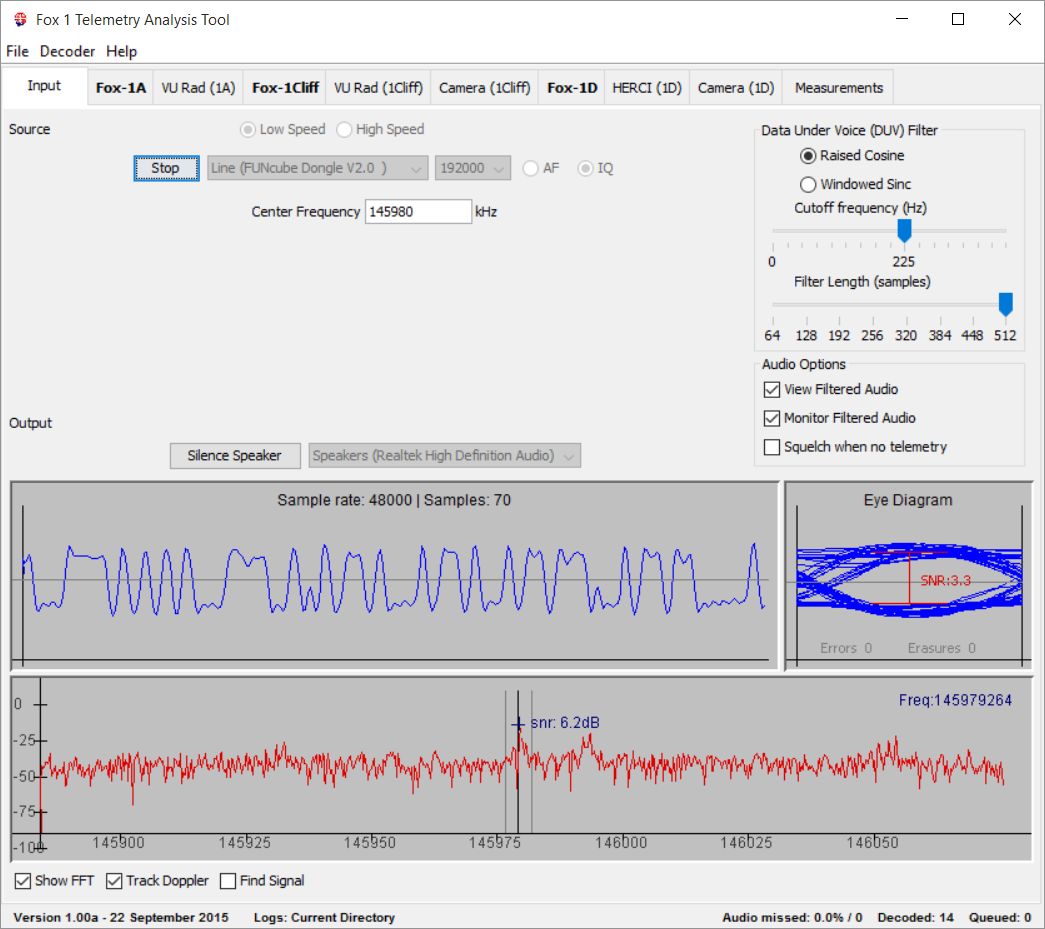
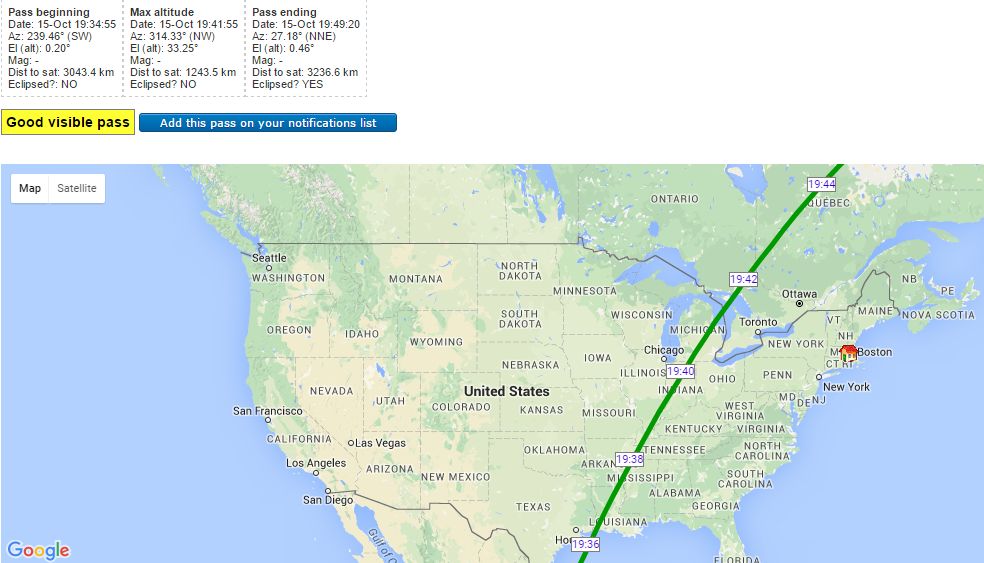
Expecting to be able to decode telemetry during a pass predicted to begin at 20:42 EDT here in FN41fn-land, I started hearing QSOs at 20:37 EDT.  They continued fast/furious until my local LOS somewhere around 20:44 EDT.  The signal was fairly strong for 7 minutes, which is to be expected when using omni antennas (egg beater).

I suspect the current TLEs are a bit off as this showed up at my QTH (FN41) about 7 minutes earlier than expected.  It also went LOS about 7 minutes early.

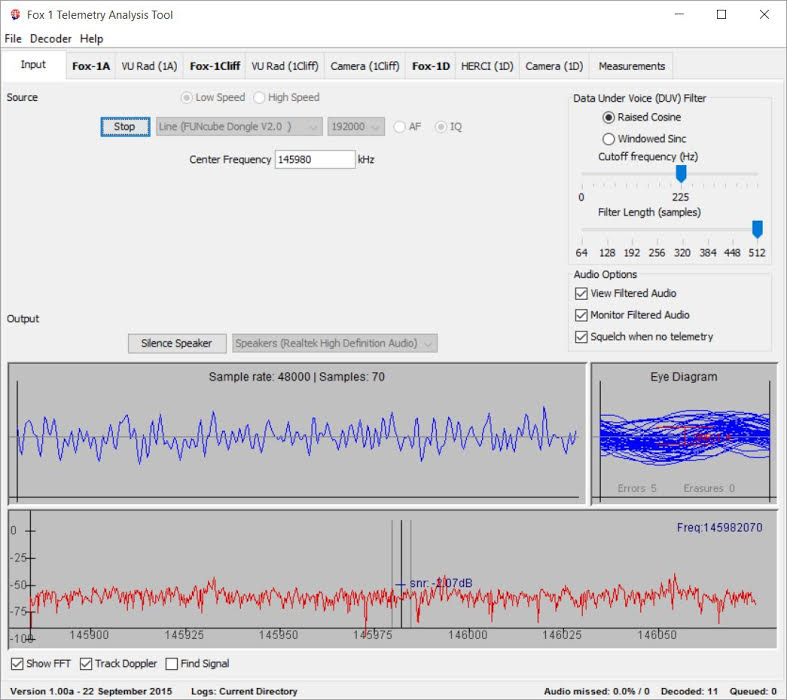
I was surprised to read that AO-85 is utilizing Data Under Voice (DUV) telemetry using 200 bps FSK, inaudible during audio transmissions — hearing voice QSOs I didn’t even bother to check telemetry decodes.  It is fantastic to have another FM bird added to the inventory (we were down to one).

AO851

Posted in Satellite | Leave a comment

Fox-1A Launch Successful

AMSATALTLOGO

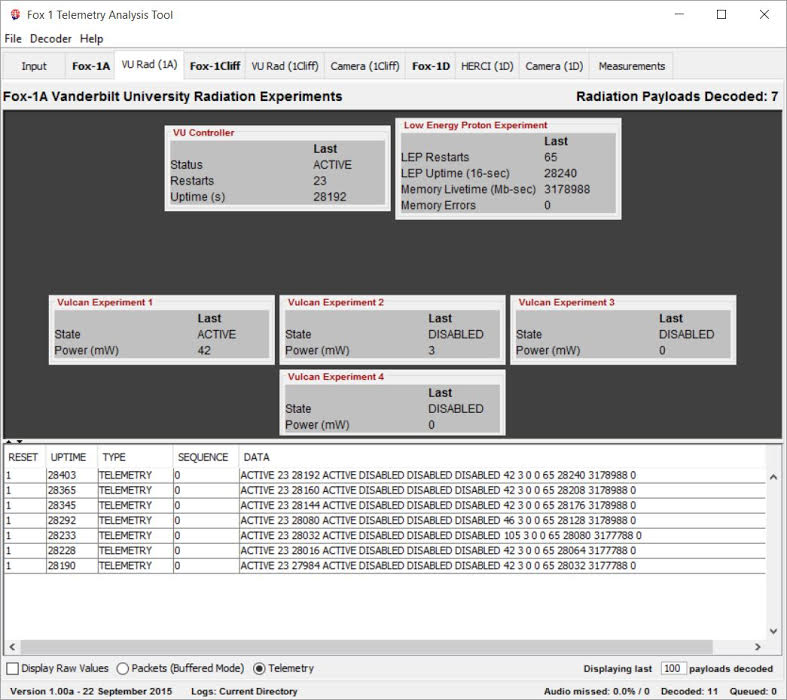
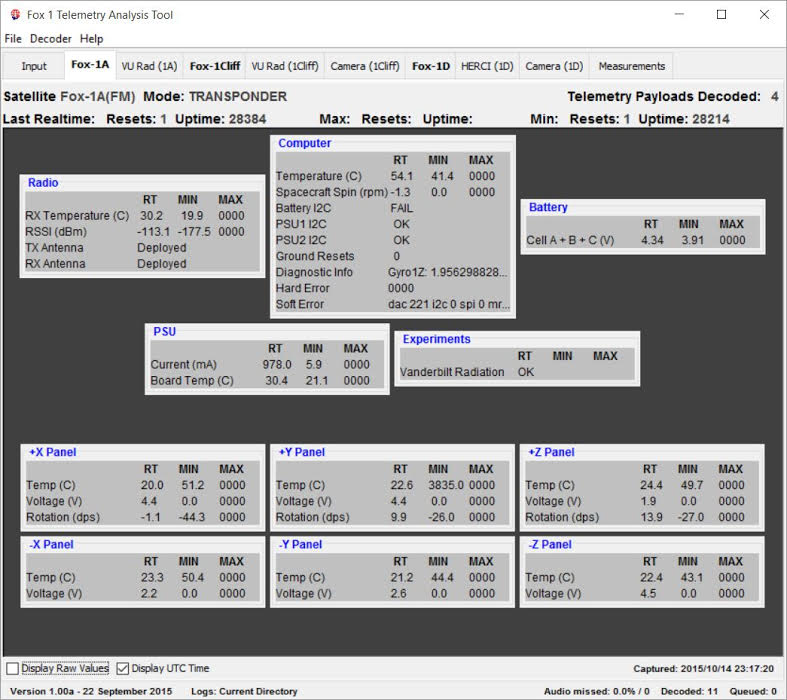
AMSAT launched their first CubeSat, Fox-1A, Amateur Oscar 85 (AO-85) on October 8th.  Telemetry has already been received, and the satellite is currently in the commissioning stage which may take a few days or a couple of weeks, prior to being turned over to full-time amateur use.

This is a mode U/V FM satellite, that should be reachable using a dual-band HT with a hand-held crossed beam like an Arrow 146/437-10BP (Split boom makes it a bit easier to pack):

http://www.hamradio.com/detail.cfm?pid=H0-010582

Here is a copy of the Fox1A Operating Guide:

http://www.amsat.org/wordpress/wp-content/uploads/2015/05/FoxOperatingGuide_May2015_Hi.pdf

Here is a copy of the latest AMSAT Journal:

http://www.amsat.org/wordpress/wp-content/uploads/2015/10/AMSAT_Journal_Fox_Launch_Special_Issue.pdf

Here is a link to the telemetry decoding software:

http://www.amsat.org/?page_id=4532

Posted in Satellite | Leave a comment

DXCC Update for Sept

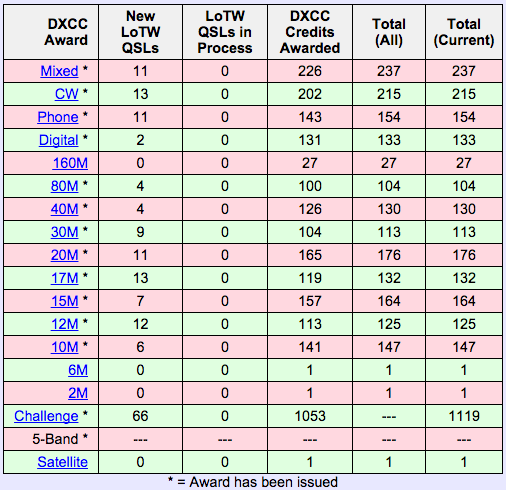
As of the end of September, I have 236 LotW entries confirmed, plus 6 QSL cards for a total of 242 countries.  Add in 27 QSL card Challenge Points to the 1118 total in LotW and it looks like I have 1145 Challenge Points.  I remain at 8BDXCC and 8BWAS.

Screen Shot 2015-10-01 at 9.28.32 PM

Posted in DX | Leave a comment

Auspicious Day for AUXCOM Completion

Eclipse

I attended a two day, 20 hour, AUXCOM training class this weekend.  It was sponsored by RIEMA (Thanks Gil Woodside and Tom Guthlein), and taught by two subject matter experts (Thanks Jim Millsap and Hank Koebler).  We had 23 students in our class, a mix of seasoned EMCOMM folks and relative newcomers — all motivated to learn and help in times of need.  The class was fantastic.

However, today (tonight, actually) was a Supermoon and a total lunar eclipse.  The photo above was taken during totality at about 2215L.  The red tones are somewhat exaggerated, but the moon is visually reddish brown.  Sorry it is so grainy but that’s the price you pay for using a F5.6 long lens.

The last time this happened (supermoon and a total eclipse) was back in the 80’s, back when ham radio and Emcomm were synonymous.  I hope this bodes well as a sign of good things to come.

Posted in ECOMM | Leave a comment

Teaching a large Technician Class in Foster RI

I’ve been teaching Technician classes for about four years now as a way of paying back the ham Elmers who started me on this path 46 years ago.  My usual class size is typically about a dozen, and I’ve been doing at least two classes a year.  Most of them have been in the East Bay (Newport County) area, and my club sponsors the classes by paying for half the cost of the student materials, plus offering those students that pass the exam a “free” BaoFeng UV5R dual-band HT when they join the club.

I was contacted by a Fire Chief in Foster RI this summer who asked me to setup a class for his team and some others this fall.  I held the first class this past Tuesday and had 25 students:  a mix of Fire Chiefs, CERT team members, and lay people from the NW part of Rhode Island and nearby CT.  It was a great group of folks and I look forward to haveing them all get their license at the end of October.

Posted in From the OM | Leave a comment

HT Shielding Impacts Close-in RDF Capabilities

My club, Newport County Radio Club (NCRC), held a dry run for fox hunting tonight in a local park (a beautiful ocean-side park, on a stunning RI summer afternoon I will add).  We wanted to try out several different antennas and approaches to RDFing.

We were using three MicroFox15 transmitters (15 mW output) hidden not far away and noticed that even at that low transmit power, when we got to within 30 feet of the transmitter, we were no longer able to discern any bearing information — the signal was equally strong 360 degrees around.

Two things could cause that.  First is simply so much RF going into the antenna jack — so much so that even a 20-30 dB front-back difference in the antenna would not be noticeable (external attenuators would help in this case).  The second possibility is that the HT itself is so poorly shielded that RF is getting directly into the radio electronics through a path other than the antenna jack.

I ran a simple experiment tonight with three different HTs by removing their antenna.  I measured the distance from the MicroFox15 to where the squelch opened up (I will call that a “S1” signal), as well as the distance when I was getting “full bars” of signal strength (A “S9” signal):

                                          S9                 S1

BaoFeng UV5R            15 feet            20 feet

BaoFeng UV82             12 feet           15 feet

Kenwood TH-D72A      1  foot             5 feet

Why is that significant?  It says that the inexpensive UV5R radios, something my club gives to new hams who join, isn’t as well shielded as it could be.  If it has a S9 signals at 15 feet with no antenna, then no RDF antenna is going to help discern direction.  But it looks like it should be usable at 20 feet.

The slightly newer UV82 model is a bit better.  But a real significant difference can be seen in my Kenwood TH-D72A — I would expect it could be used to get within 5 feet of the fox.

This won’t be a concern far out, but close in, where you need to be to find the tiny MicroFox15 transmitter, requires some shielding considerations.

Posted in RDF | Leave a comment

First AO-73 QSO in a Long Time

I was able to have a short QSO with Rick, W2JAZ tonight about 01:58Z on AO-73.  As I’ve been seeing over the past couple of weeks, the uplink offset is pretty far off the published specs and seems to get worse with time.  Despite using TLEs from today, the Doppler correction seems to be off substantially as well, shifting about 3 KHz from start to finish (despite TX and RX Doppler correction from Sat32PC).  I don’t have these issues with either FO-29 or AO-7.

After calibrating Sat32PC at mid-pass, my DOPPLER.SQF line value for CW was:

“AO-73,145957.52,435160.48,CW,CW,REV,,, Transponder”

Note that the published figures says that 145.957.5 should be about 435.142.5, so my correction value is about 18 KHz higher than published values.  These are with respect to the satellite (what the satellite sends and hears).  At my end, the IC-9100 RX was 145.964 and TX was 435.162 after both were corrected.

So the big mysteries that haven’t been answered since AO-73 transponder was turned on in November of 2013, are:

  1. How come the Doppler isn’t adequately corrected given most recent NORAD TLE values?
  2. How come the TX to RX relationship is so out of wack?
Posted in Satellite | Leave a comment

TNC-Pi for Raspberry Pi 2

I just ordered a TNC-Pi 2 (they have a model for the older Pi versions as well) from Coastal Chip Works on Wednesday.  It was in my mailbox on Friday – FAST service!

Nice looking board, well put together.  I’m curious to see how well XASTIR works on the Model 2 Pi (it was reported to be “sluggish but acceptable” on the original Pi.).  The higher clock speed should be a 2x improvement and quad cores should help as well.  Hopefully it is peppy.

RPi APRS

As it extends the entire I/O connector, it is very easy to plug an Adafruit Ultimate GPS module on top of it.

Posted in APRS, Digital Mode, Gear, Raspberry Pi | Leave a comment

Speaking of FUNcube-1: Certificate and QSL Now Available

AMSAT-UK announced that a ‘Certificate of Achievement’ and/or a amateur radio style ‘QSL’ card for FUNcube-1 are now available online.  Assuming that you’ve entered at least one telemetry report into the data warehouse, then you can print them yourself here:

http://amsatuk.me.uk/on/funcube_qsl.php

WB4SON Funcube Achievement

WB4SON FunCube QSL Front
WB4SON Funcube QSL Back


Posted in From the OM | Leave a comment