Lost (but found?) Secret Sauce for AO-73

Shortly after AO-73 was launched, I had decent success working several stations, but only after adjusting my uplink frequency up about 8500 Hz from the published value.  Unfortunately, I never calibrated SatPC32 the correct way, so I was always entering that value as a XIT offset to my IC-9100.  Before this year’s field day, I figured I would correct the calibration, and had no issue doing this for both FO-29 and AO-7.  However I was no longer able to hear myself anywhere on the AO-73 downlink, despite adjusting my uplink by +/-12 KHz.

I had pretty much given up on the bird, when I worked Jeff, NX9B, on FO-29 during Field Day.  I emailed him, thanking him for the contact and mentioned my troubles.  He responded that he too had issues with the published uplink/downlink relationship, and supplied me with his SatPC32 DOPPLER.SQF entries for AO-73.

I tried his values, and adjusted my Sat32PC “Upl. Calibr. (Hz)” setting until I heard myself.  This took ANOTHER 5200 Hz at the start of the pass, shifting upward to 6200 Hz by mid-pass.

I was VERY surprised to find that from the satellite’s point of view (Doppler corrected to reflect the frequencies at the satellite), I was at 145.960 (the middle of the published satellite TX pass-band), and the satellite RX was 435.159.  That is 9 KHz outside of the published pass-band for the TX, and 19 KHz above the published relationship between RX and TX.  Again, these values are about 6 KHz higher than those used by Jeff.

Unfortunately my testing was limited as the bird went out of eclipse about mid-pass and the transponder was turned off.

I confirmed this again on the 2nd pass at approximately 03:08 UTC.  At a satellite TX of 145.960.384, the published satellite RX value would have been 435.139.616.  Instead I saw that the RX value was 435.159.616 — this was 20 KHz higher than the published value).

(I verified that the TLE that was being used by Sat32PC matched up with those published by Celestrak On July 27, 2015).  I also verified that the AO-73 entry in AmsatNames.txt was correct (39444 13066AE  AO-73) )

FUNCUBE-1 (AO-73)       
1 39444U 13066AE 15208.17816161 .00000549 00000-0 76602-4 0 9990
2 39444 97.7279 269.4651 0059736 6.9191 353.2833 14.80359877 89338
Posted in Satellite | Leave a comment

ARISS Contact: One Step Closer

I am one member on a team of folks who have had our initial proposal for an ARISS contact sometime between Jan and June of 2016.  The initial “marketing” proposal was accepted.  The next step in the process is to have our technical proposal accepted as well.

ARISS requires a primary as well as a backup station with pretty robust RF requirements on both the RX and TX side — well in excess of what the normal link margin requirements would be.  This is to accommodate a horizon-to-horizon contact (only about 10 minutes — ISS is in very low orbit), to overcome signal difficulties on the ISS end caused by less than ideal antenna locations and power output, and to ensure our signal is the strongest during the space station pass.  It’s all pretty specialized and fairly expensive gear.

The good news was that our initial technical proposal was reviewed by our ARISS Technical Mentor this afternoon and was given an initial positive review.  We need to add a high power amplifier and RX preamp to our backup station, and consider adding a RHCP-LHCP polarity switch to our primary station.

Hopefully we will have an approved proposal and move onto the scheduling step within the next few weeks.

ariss_logo

Posted in ARISS, Operating, Public Service, Satellite | Leave a comment

GOTA Summary – Field Day 2015

I’ve been organizing the GOTA operation for my club’s Field Day for the past several years.  Each year our goal is to max out our GOTA contribution, a goal that we’ve never met.  Depending on your definition, we either did or did not this year.  That uncertainty reflects the almost absurd complexity of the GOTA scoring system.  While many rules require a main rule number, and a sub-point (like 4.1), GOTA is overboard silly with rules like 7.3.13.1.

Certainly by one standard we did max out.  GOTA can make up to 500 QSOs.  We did that before midnight on Saturday.

The confusion of GOTA mostly surrounds the bonus system.  If operators make QSOs in sets of 20, then you get a 20 point bonus.  And if a GOTA coach was present the entire time, then that 20 point bonus is doubled to 40 points.  But wait, a single operator can make no more that 100 QSOs that count toward the GOTA bonus.  If they go over 100, that’s OK, but there is no bonus beyond the 100+100 points.

Finally there is another bonus, typically associated with GOTA; a youthful bonus.  If there are operators that are under 18, then each one is awarded 20 bonus points up to a maximum of 100.

So here is the break down in terms of maximums:

500 reported QSOs
500 maximum bonus if those are done in sets of 20 not exceeding 100 per operator
500 bonus if there is a GOTA Coach for the entire event
100 bonus points for up to 5 youthful operators
==========================================================
1600 Maximum GOTA Points

But WAIT, those 500 reported QSOs get doubled for lower power (< 150 watts).  So in our specific case the maximum point contribution for GOTA is 2100 points.

Our point contribution was 1940 points.  Although we had eight operators, only 3 made a set of 100.  One made a set of 40, and 4 others made a set of 20.  So that was 420 out of 500.  And of course those 80 missed bonus points doubled to 160 (GOTA Coach Bonus).

So did we or did we not max out?  Most folks consider making 500 QSO “Maxed-Out”, we did that.  But I don’t think we did because we left 160 points on the table.

Something left to shoot for next year!

Posted in Contests, Operating, Public Service | Leave a comment

Cycle 24 Musings and Goal Review for 2015

The planet took a beating about ten days ago from Sunspot 2371, which produced one of the larger geomagnetic disturbances of the Cycle 24 when the CME hit the earth around noon local time on June 22.  This event and several others had D-Layer absorption at record levels (the absorption at 15-meters was 35 dB at one point), and produced a G4 level geomagnetic storm. Inline image 1

Cycle24Absorption

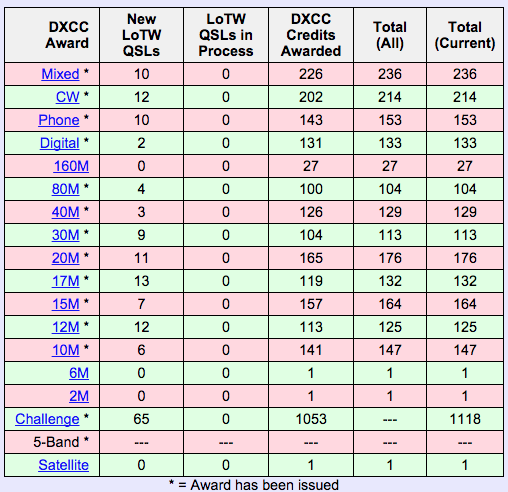
Fortunately, things calmed down a bit for Field Day, and the SFI remained just above 100, with 20-meters open the entire time.  Sadly, 15 and 10-meters were pretty much no-shows this year.  With the SFI under 100, and the half-way point of the year reached, its time to look at the my goals for 2015: WB4SON DXCC July 1 2015With QSL cards in hand today, I’m sitting at 239 Mixed, and 1122 Challenge points (I hope to travel to ARRL HQ this month to have the cards checked).  At the end of 2014, I had 218 Mixed countries confirmed, and 954 Challenge points.

Three of my year-end goals remain:

  • Complete firmware for satellite tracker (maybe 20% of the way there)
  • Hold two ham radio classes (I’ve completed one and have another scheduled in Sept)
  • Participate in four VE sessions (I’ve completed two)
Posted in DX, Propagation | Leave a comment

Field Day Irony

Well Field Day 2015 has come and gone, and I was able to snag another satellite contact to help garner some bonus points for my club (Newport County Radio Club) — Thank you NX9B, I was W1LY on the other end.

Despite multiple attempts in the days prior, I was never able to hear my own downlink on AO-73.  I’ve worked dozens of stations on that bird in the past, and had noted some rather large discrepancies in the published relationship between uplink and downlink frequencies, which I had adjusted for manually in the past.  But my attempts to calibrated things so this would be factored in automatically were not successful, so AO-73 was off the table for this Field Day.  Still, the AO-7 and FO-29 calibration went well.

AO-7 was launched in 1974, worked well until 1981, when the batteries failed in a shorted mode.  A decade later, in 2002, one of the failed batteries went open circuit, which has allowed the spacecraft to operate off of solar power.  As it passes from being eclipsed by the earth and into sunlight, it can restart in one of two modes, Mode A, or Mode B.  Last year, my FD contact was through AO-7 using Mode B.  This year, I could not hear AO-7 at all during the first opportunity, so that probably means it started in Mode A — luck of the draw.

FO-29, young by comparison as it was launched in 1996, continues to work fantastically well to this day.  The first available pass happened right around 3 PM local time, just about a half hour after the unsuccessful AO-7 pass.  Almost immediately, I made a CW contact with NX9B.  But as I continued to call CQ hoping to provide a contact for other clubs that might need one, no one else responded, and something went wrong with the 2-Meter transmit path toward the end of the pass.

Well, the good news is that I made the 100 point bonus satellite QSO with NX9B’s help.  The bad news is I am off the air until I figure out what went wrong.  And the AO-73 calibration issue remains a mystery to be solved later.

IMG_2855

Update June 30:  Bench testing of the IC-9100 ruled out any issue with the radio, so the defect was in the antenna, and the suspicion is that the Gamma Match has failed.  But that’s a $25 problem.  Whew!

Posted in Contests, Operating, Satellite | Leave a comment

Satellite Uplink Calibration

I finally had some time to ensure that my SatPC32 program was correctly calibrated to my Icom IC-9100 when using any of the three available linear transponder satellites.  While SatPC32 deals with doppler corrections (assuming the PC Clock is accurately set and the Keplerian Elements for the satellite are up to date), additional corrections are necessary to accommodate differences in published uplink/downlink satellite frequencies, and for any inaccuracies in the rig.  Optimally this uplink correction should be done independently for SSB and CW, but given time constraints, I decided to assume all my operation would be in the CW+ (CW enabled mode) based on the SSB Transponder data.

During the 18:26 to 18:46Z pass of AO-7, I used the SatPC32 “CAT” command then adjusted the “Upl Calib Hz” command until I heard my CW downlink roughly match my sidetone.  For my rig this was +4800 Hz (adjustment based on the default Doppler.sqf file that SAT32PC ships with).  The calibration data is saved by pressing the “Change/Store Data File” button, then the “Store Uplink Calibration” button.  The Sat32PC Doppler.sqf file was modified so that the AO-07 entry reads “AO-07,145950,432151.1,USB,LSB,REV,0,0,Mode B”

During the 19:04 to 19:18Z pass of FO-29, The uplink calibration turned out to be -100 Hz.  My Doppler.sqf file entry was adjusted to “FO-29,435850.45,145952.05,USB,LSB,REV,0,0”.  Note that the offsets were “435850.45,145952.15” prior to calibration, which makes sense.

Following calibration, I made a CW QSO with W1SJ in FN34 at 19:10Z using FO-29 on 435.840RX and 145.962TX.

During the next AO-7 pass (20:18 to 20:40Z), I worked NM3B from FN01 at 20:23Z (432.153TX/145.943RX) He was 599 and I was 579.  I also worked WC7V from DN45 at 20:31 (432.168TX/145.938RX) He was 569 and I received a 559.

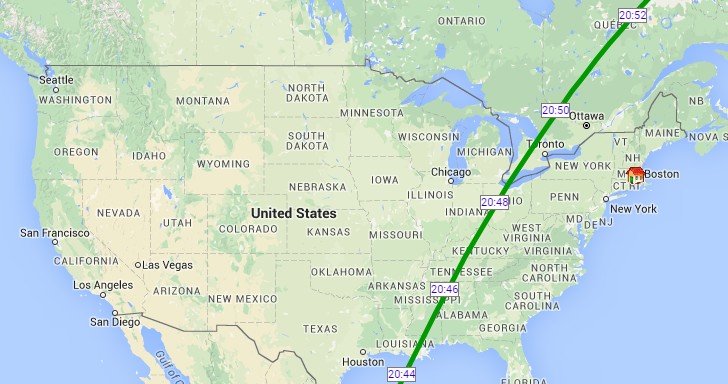
AO-73 is in Beacon Mode until the satellite is in eclipse.  I was expecting that to happen during a pass around 10 PM local time (June 26 from 0207Z to 0219Z).  Unfortunately I was unable to hear my downlink as I tuned the uplink correction through +/- 20 KHz.  This was quite odd, as the last time I worked AO-73 it (and I) had a booming signal.  I double checked that I was somewhere around 435.140 up and 145.960 down (the midpoint of both the uplink and downlink).  The program appeared to be properly setup in terms of definitions.  Hearing nothing, I tuned down to 145.935, the approximate frequency of the telemetry beacon — I thought I heard it faintly (which is the case if the satellite is in transponder mode), but it was also toward the very end of the pass.  Unfortunately I can’t try again until Friday night.

Posted in Contests, From the OM, Satellite | 2 Comments

Field Day 2015 Satellite Passes

With only a single operating FM satellite (FO-50), there is almost no chance to work it during Field Day.  The best chance is provided by one of the three operational analog satellites:  AO-7, FO-29 and AO-73.  AO-7 is an ancient bird, of course and the batteries failed decades ago, so it is only usable when it is in full sunlight.  For FN41 (Rhode Island) the following passes are usable (all times local, red text is optimal pass):

AO-7 Passes (AOS   Mid   LOS)

27-Jun 14:19 SE
122°
14:29 NE
56°
30° 14:39 N
350°
27-Jun 16:11 S
170°
16:22 WSW
254°
67° 16:33 NNW
341°
27-Jun 18:08 SW
226°
18:16 W
273°
11° 18:24 NW
323°
28-Jun 06:05 N
12°
06:15 WNW
298°
46° 06:26 SW
223°
28-Jun 07:58 N
08:06 NW
321°
11° 08:14 W
276°
28-Jun 13:22 E
95°
13:31 NE
45°
14° 13:39 N
355°


FO-29 Passes (AOS   Mid   LOS)

27-Jun 14:59 SE
149°
15:06 ENE
72°
48° 15:13 N
353°
27-Jun 16:45 SSW
205°
16:52 W
268°
19° 16:58 NNW
331°
28-Jun 03:50 NNE
19°
03:58 E
99°
47° 04:08 S
178°
28-Jun 05:36 N
05:43 WNW
294°
31° 05:52 SW
226°


AO-73 Passes (AOS   Mid   LOS)

27-Jun 21:11 SE
141°
21:17 ENE
71°
30° 21:23 N
359°
27-Jun 22:47 SSW
198°
22:53 W
265°
23° 22:59 NNW
333°
28-Jun 10:34 NNE
16°
10:40 E
99°
61° 10:47 S
185°
28-Jun 12:11 N
350°
12:16 WNW
298°
12° 12:21 WSW
244°


Posted in Contests, Satellite | Leave a comment

Momento for W1AW/1 RI Operation

When I checked the mail today, I was pleasantly surprised to find a small desk plaque commemorating my participation this past year as a W1AW/1 – RI station.  They mounted a centennial and W1AW challenge coin into an engraved case saying “WB4SON was W1AW/1 RI”  — VERY nice!

WB4SONwasW1AW:1RI

Posted in From the OM, Operating | 1 Comment

Worked All W1AW Plaque Arrives

Yesterday a box that was about a cubic foot showed up on my doorstep.  Expecting something heavy I almost tossed it over the roof when I picked it up — it weighed less than 2 pounds.  I didn’t recognize the return address, so that added to the mystery.  Inside, surrounded by two injected foam inserts was my Worked All W1AW Plaque.  I had ordered that almost three month ago.  They must really treasure those plaques (I certainly do) because they were packaged like it was a rare work of art.

W1AW Plaque


As a newly licensed Novice back in 1970, working W1AW was my dream, and over the ensuing years I worked them numerous times (any time I would hear them on the air).  So last year’s W1AW portable event was a dream come true.  I look forward to receiving a large pile of QSL cards from all the different states they operated in.

Posted in From the OM, Operating | Leave a comment

A Documentation Solution for Shelter Radios?

One of the hats I wear as a volunteer is supporting RI’s Red Cross communication (part of what ARC calls “DST” or Disaster Services Technology).  During a particularly bad winter storm, one of our shelter comms operators contacted me at the ARC EOC to let me know that the VHF radio used with the ARC Repeater was not working as expected.  This feedback became part of the After Action Report.

While a check of the radio indicated it was functioning correctly, it is more than likely that the issue had to do with a lack of documentation for the radio controls and channel definitions.  While some documentation existed back at HQ, it never made it out with the radio during deployment.

As a corrective action, I decided to make a laminated 3″x5″ index card that would document the radio controls on one side and the channel programming on the other.  A different card was created for each of the different radio types in use at our shelters.  The card is laminated and fastened to the radio like a luggage tag.

TK760DataCard

Posted in ECOMM, Public Service | Leave a comment