IS-700.a National Incident Management System

Well, I took the course and exam for IS-700.a, which is an overview of the National Incident Management System.  The course itself and the exam were not nearly as well crafted as was IS-100.b.  Exam questions were often long winded with some rather minute details distinguishing correct vs. incorrect answers — so careful reading was required.  In addition this exam had multiple instances of answers in the “negative” (like “all the above are true EXCEPT”), which is generally considered by educational professionals to be a questioning technique that leads to errors — becoming as much a test of test taking skills as the subject matter at hand.  I also felt that this was much more vomiting back, word for word, lists from the class summary rather than asking someone to think critically and respond with an appropriate answer.   From the “big picture” point of view, the class is excellent because it shows how all the pieces fit together on the National, State, Local, NGO, and Private Sector.

The course wasn’t hard, and took about 2.5 hours from beginning to end, including test time.  With a bit of luck I will receive the certification in a few days, completing the minimum required training to participate in various state and local exercises.

The time for training and planning is BEFORE those skills are put to practical use.  So maybe readers of this blog could put the fall and winter to good use and get credentialed.  See the ECOMM page for more information.

Posted in ECOMM, From the OM | 1 Comment

One down, one to go…

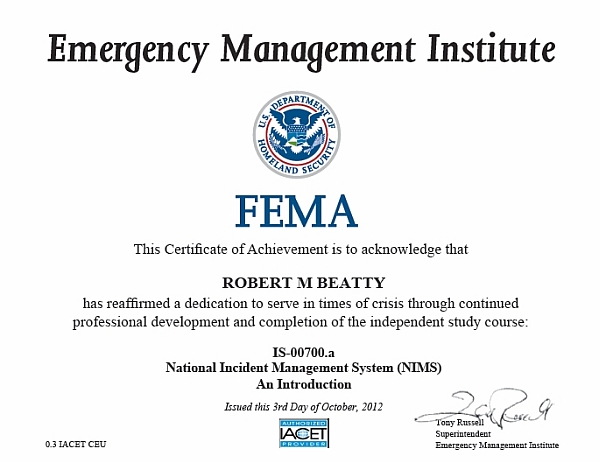
And just like that, 12 hours later, I have a FEMA certificate in hand:

Incident Command System Certification

Next up, IS-700.a

Posted in ECOMM, From the OM | Leave a comment

FEMA Courses for ECOMM

In order to participate in inter-agency emergency response training,  many jurisdictions are requiring completion of one or more FEMA courses. The two frequently required are IS-100.b and IS-700.a. The course are independent study and are offered online here.

I took the IS-100.b course and exam today.  This is the “Introduction to the Incident Command System”. It took 3 hours and 15 minutes to complete the course (and watch the Pats lose to the Ravens) and take the exam. The course consisted of about five lessons plus an introduction and summary.  Each lesson has online review exercises.  The online material included some PowerPoint-like slides and some multimedia.  It defined what the Incident Command System (ICS) is, how it is applied, how it is organized, including a description of position titles and responcibilities, what facilities used, and planning.

After taking the exam and entering some personal information I was informed that I would learn the results within a day or so and be issued a PDF certificate if I scored at least 75% on the exam (19 right out of 25).  Quite honestly, I felt like the exam touched on all the major important points and did not dwell on minutiae.  I also felt that all questions had one obvious correct answer and three obvious incorrect answers.  I was pleasantly surprised.

FEMA Course Decoder Ring:  The “IS” part stands for Independent Study (Web-based course).  This is followed by a classification code that keeps similar things grouped.  Finally if the class material has been revised, there is a revision code like “.b” following the number.

See the ECOMM tab on the black bar for more info.

Posted in ECOMM, From the OM | Leave a comment

There is a Secret DX World at 4 AM

I figured what a great way to check out my new K3 Sub-receiver than joining in the NH8S pileup.  Since I’ve had my K3 apart for about a week (too much going on to finish it quickly), I’ve missed all the early fun (other than noting some big pileups during the day yet never actually hearing NH8S).  I decided to get up at 4 AM this morning and see if I could work the Swains Island DXpedition since their propagation tools predicted peak signal strength to the New England area on 40 meters between 4 AM and 6 AM.

Sure enough, they were running split SSB on 40 meters when I turned the rig on, but NOBODY was working them.  The poor op was calling CQ over and over again.  One call and he was in the log, weak, but there.

I then shifted to 30 meters, which provided a booming split CW signal from NH8S, but I was unable to hear any responders, so I just picked a spot and made a contact after 20 minutes of trying.

My final attempt was on 20 meters.  NH8S was booming on CW there, transmitting just below the Extra segment.  The crowd was hammering away a few KHz into the General segment.  I spent about 30 minutes listening in that mess but I never found anyone working him using the sub.  However, when I eventually started listening in the Extra class segment, it quickly became apparent that he was listening there.  Sure enough I found a responder, and made my call on that frequency, and was rewarded with NH8S on the third band.  Not bad for an hours effort.

Moral of the story — sometimes being a night-owl isn’t great for DX into Asia and Oceania.  You need to get up before the sun to find that Secret DX World.

Followup to the story:  About 10 hours later the QSOs appeared in their online log.  Thanks to the NH8S crew for putting up with 110 degree heat, sand everywhere, and huge pileups.

Posted in DX, From the OM | Leave a comment

KRX3 Sub Receiver Springs to Life

Despite being pretty successful using my P3 to visually locate the spot where a DX Station is listening in a split-mode pileup, with the number of people that just transmit blindly even when instructed not to, sometimes visual just doesn’t work.  I’ve been assured by other K3-owning friends that the second receiver is the way to go.  You listen to the DX station in one ear on the main, and tune the sub to find the station he is responding to, then set your transmitter to that frequency to “tailgate” on the next “QRZ?”.

With the announcement that Elecraft prices would be increasing, I decided now was a great time (rather than later) to pick up the Sub Receiver, a couple of filters, and the P3’s SVGA enhancement.  All those goodies came in about a week ago.

I had been advised that a methodical approach to installing the sub receiver inside an existing K3, which involves a fair amount of mechanical disassemble, would take about 3 hours.  In my case I was probably a tad past the half way point after 3.5 hours (including the time to install the modification to boost the capacity of the 12VDC Switched Power jack to 1 Amp — enough to run that P3/SVGA combo).  I managed to complete the assembly over a couple of lunch breaks, bringing the total to 5.5 hours.  I suspect I could do a second one in about half the time, and have a better feeling for what makes the K3 tick now as a happy unintended consequence of doing the install myself.

Elecraft Quality plus slow and careful paid off.  When I powered the K3 up after work today, there was sound from the speaker, and no smoke from the rig.  The setup process to enable the sub receiver and calibrate the second synthesizer went smoothly as did entering all the additional filter info.  The only “glitch” was that you had to power the rig off then back on after enabling the sub receiver to truly enable the sub receiver.

Now to work NH8S

Posted in From the OM, Gear | Leave a comment

E51M North Cook Islands LotW Confirmations Arriving

My E51M LotW confirmation arrived today.

My thanks to DK9KX, DJ9KH, SP3DOI, DL6JGN, DH9HX, PA3EWP,  and DJ8NK for all their hard work getting E51M on the air.

Posted in DX, From the OM | Leave a comment

Why I like LiFePO4 Batteries For Ham Applications

Honestly, I keep going on and on about this, but its been a long time since I’ve found something that just keeps amazing me (my Elecraft K3/KX3 and Honda EU2000i fall into that category), and LiFePO4 batteries are one of those things.  Their operating range just seems to fall into the sweet spot for ham applications.

When I’ve compared my SLA battery to my LiFePO4 battery in C/2 discharge tests, it was apparent that the SLA battery was not performing anywhere close to its nameplate rating but I was worried that the age of the battery might have a significant impact.  So I purchased another SLA battery and cycled it a half dozen times (C/20 discharge and charge) to ensure it was “fresh” then reran the tests.  I also retested my K2 Energy battery, which will be 2 years old in January, along with a similar age SLA battery.

Lets begin with the test of my 2 year old “GP” SLA battery, whose nameplate capacity is 7.2 AH, so the C/2 discharge rate is 3.6 Amps.  It reached its cutoff voltage and illustrated a discharge capacity of about 4.3 AH (or about 60% of nameplate).  Withing 15 minutes its terminal voltage was at 12.0 volts, and was at 11.0 volts after 56 minutes:

Here are the results for my brand new Powersonic PS-1270.  It is rated at 7.0AH, so the C/2 discharge current is 3.5 Amps.  It fared a bit better, being newer,  hitting the cutoff voltage after 5.25 AH (75%).  This battery remained above 12.0 volts for almost 50 minutes, and was at 11.0 volts after 88 minutes:

Both of those SLA Batteries illustrate several problem of SLAs:

  • Their terminal voltage is not very stable
  • They don’t provide their nameplate capacity under real-world circumstances C/2 load vs C/20
  • Their capacity declines with age

Now examine the discharge curve of my almost 2-year old LiFePO4 battery.  Since it has a nameplate rating of 9.6 AH, the C/2 discharge current is 4.8 Amps.  It reached its cutoff voltage (10.0 volts actually higher than the 8.0 spec) with a capacity of 9.2AH (96% of nameplate).  The battery remained above 12.0 volts for 105 minutes, and above 11.0 volts for 113 minutes).

It should be immediately obvious that the discharge curve is MUCH flatter.  Essentially the battery remains around 12.7 volts for about 85 minutes then took another 20 minutes to drop down to 12.0 volts.  This higher operating voltage is a real blessing for 12 volt ham gear, which was really designed to operate on a 13.8 volt supply.

And I should mention that the correct cut-off voltage for this battery is actually 8.0 volts, so, in fact, had I let it discharge that far, I probably would have seen a couple % more capacity (96%), and the battery age doesn’t seem to have a huge impact.

So what’s the bottom line?  SLA batteries don’t come very close to their nameplate capacity when operated at a C/2 load.  And although two points don’t make a great trend, it appears that they suffer capacity loss over time (not surprising).  On the other hand the LiFePO4 battery is still very close to its nameplate capacity even after 2 years of use.

Perhaps more importantly, while the LiFePO4 battery has a terminal voltage above 12 volts for about 85% of its capacity, the SLA battery will drop below 12 volts after less than half its capacity has been used.

This LiFePO4 battery will last 4-5 times longer than a SLA, will keep 75% of its capacity or more after sitting idle on a shelf for a year, and weighs about half what the SLA battery does.  Plus it is not hazardous waste.

In the future I will rerun the tests at 2 Amps for all three batteries, which is the current draw of the Elecraft KX3 on full power, and will terminate the test at 10.5 volts, which is the minimum recommended discharge voltage for a 12V SLA.

Posted in Uncategorized | 1 Comment

Lessons Learned From Installing the K3 12VDC Out Current Modification

This weekend I decided to tear my K3 apart.  It had been working flawlessly since January, and no good deed goes unpunished, so it was time mess up a good thing.  I wanted to install the second receiver (KRX3) and add a SVGA board to my P3, which requires removing three components from the main PCB to increase the the current output capability of the switched DC jack used to power the P3.

How hard could that be?  Well not very from a rework point of view.  The SMT diode D34 is easy to remove and replace, and even easier to get to (remove the bottom cover).  Some solder braid quickly removed the solder holding it down and gentle tweezing action  lifted the old part off.  After cleaning up the pads and putting on a bit of no-clean solder, the new part was installed.  Just watch the polarity per the instructions.

The other two part, both leaded, were more of a chore, but mechanically, and this was my big got-ya.  I was convinced that I didn’t need to remove the PA assembly (they said that part was optional) as I had pretty clear view of things.  But unfortunately, when the bottom cover was removed, two standoffs, screwed to the main PCB, which support the bottom cover, had come off with the bottom cover itself.  The screws and washers had fallen inside the PA area.  Looks like the standoffs and screws had not been properly torqued at assembly time (at the Elecraft factory), as the standoffs should have remained firmly bolted to the board, not the bottom cover.  So I had to take the PA assembly out anyway.  You can bet I socked the screws down when I put things together.

When it came time to remove the two leaded parts, RFC48 and F2, my recommendation is to use a solder sucker.  This is because all the solder has to be removed from the holes to make enough clearance for the new parts (especially F2 which has substantially thicker leads).  F2 came out like a dream, with one pass of the solder sucker per lead.  But RFC48 was not as successful, despite even more clearance — I think this was due to thermal conductivity of the ground plane cooling things down quickly.  Rather than bugger things up, I resoldered the part, then melted the new solder, holding the iron on for a longer period of time, then sucked the solder out on the next attempt.

Putting the new parts in was a snap.  Were it not for the time involved in correcting lose standoffs, it would have taken 30 minutes.  Instead it took over an hour as I wanted to locate the missing hardware before I turned the rig over and lost something in the process.

So my warning to anyone installing that modification yourself:  Make darned sure the standoffs remain attached to the PCB, and things haven’t come lose when removing the bottom cover.  If they are lose sock them down before things fall apart.  In fact, it might be a better idea to remove the top cover and sock those screws down BEFORE taking the bottom cover off.  They are the same three screws that hold the aluminum bracket that holds the PA assembly onto the main PCB.  Of course one of them can’t be reached without removing the PA (which is no big deal in reality).


Posted in From the OM, Gear | Leave a comment

The March Toward DXCC 200

I set goals to work 200 countries before the end of 2012, to have 150 confirmed in LotW, and 150 in the Diamond DXCC Challenge.  As of this afternoon, after working A92IO, Dave in Bahrain, my country count is up to 190.  LotW is lagging quite a bit with 137 confirmed (plus a physical QSL), and I’m at 133 in the Diamond DXCC Challenge.  So there is still lots of work to go (and QSLs to mail out).  But things seem hopeful.

Update:  A few hours later, Dave, A92IO confirmed, along with Oleg, RI1ANF in South Shetland Island, bumping LotW up to 139.

Posted in DX, From the OM | Leave a comment

Linking your CQ WPX Award Record with LotW

I was very excited when the ARRL decided to add support for CQ WPX Awards to the Logbook of the World.  I had previously applied for a mixed award through eQSL when I had reached 400+ different prefix confirmations using that service.  Once the ARRL activated theirs, I was at 500+.  It seemed silly to apply again so I decided to wait until I reached the Honor Roll level of 600+.

When checking on my progress today, I noticed a new tab called “Link Account” was now showing up under the Awards/WPX category.

After Clicking the horizontal “Awards” tab, and clicking on the “Select CQ WPX Award Account” button on the bottom-left, you will see this screen.

If you click that, you will be taken to the screen shown below, which allows you to enter information for the CQ Awards Manager (A wonderfully helpful fellow named Steve).  He will then upload any electronic information he has in your WPX file.  Within moments of filling out that form, I had an email back from Steve telling me he had just uploaded my information.  A quick check of the LotW CQ WPX award indicated that I now had 634 Mixed entries.  A few minutes later I submitted a new application for the 600 level (Honor Roll) WPX Mixed award.  Too easy!

Now if only the calligrapher could catch up.  I still haven’t received my first WPX Award certificate from my eQSL submission in early June, prior to the LotW system turning on.  But they do warn you that it can takes several months to receive the certificate.

The LotW “Link Account” screen shot


Posted in From the OM | Leave a comment