An Unexpected Supprise

Last night, tired from trying to scratch out a new country in the CQ WW CW contest, I headed upstairs for bed somewhat dejected.  On my way up I noticed a large envelope from the ARRL.  I guess I thought it was related to the Diamond Club, which I had recently renewed, so I almost didn’t open it.  But it tuned out to be something entirely unexpected.  Last November I had participated in the 160 meter contest.  Turns out I won for Rhode Island in the QRP category.  Yea, sort of.  While I’m happy to have won, there are a few things to consider.

First, not many hams have antennas capable of working on 160 meters because they are so large.  My loop, at 450 feet, is about 100 feet too short, and about 100 feet too low to be very effective on 160 meters.  But I can still load it up and it does work.  Next few hams are in Rhode Island to begin with.  Finally, only a fool runs QRP on the nosiest band of them all.

I figured that all the above might present me with an opportunity.  And it did.

First Place, Single Op, QRP, 160 Meter Contest

Posted in Contests, From the OM | Leave a comment

Lesotho Africa is country #200

It took about 35 minutes of trying to get through, but I was able to contact 7P8D during the CW CQ DX contest at 01:55 UTC.  According to my logbook (HRD), Lesotho, Africa is country #200 in the log.  It is nice to get this goal for 2012 completed a bit early.

ZP8D is the on the air due to a multinational team.

Posted in Contests, DX, From the OM | Leave a comment

Successful test of FLDIGI/FLMSG/FLWRAP

Mike Cullen, K1NPT, of NewportReady fame, and I ran a series of experiments over 2 meter simplex for a couple of hours tonight.  We wanted to get our equipment setup to use FLDIGI and various accessory modules (FLMSG, FLWRAP, FLRIG, etc.).  In Mikes case, he was using a 10 watt rig with a SoundLink USB interface attached to his computer.  I was using the integrated USB command/audio port on my IC-9100 and about 25 watts.

Our initial attempts to get keyboard to keyboard messaging using MT63-2000 failed for a couple of reasons.  On my end, the audio output level from the IC-9100 was over driving the USB CODEC.  It was necessary to adjust the “Recording Device” slider for the USB CODEC down to level 1 (out of 100).  That gave about a mid-scale audio reading on the FLDIGI VU meter (lower right green bar), and a waterfall that wasn’t stuck at bright yellow all the time.  On Mike’s end, he had to configure the MT63-2000 modem to disallow manual tuning which would allow the tones to be shifted manually.  While that might be a nice feature for HF, it isn’t desirable for VHF-FM which isn’t drifting around — his tones had accidentally been shifted down 500 Hz.

After working those kinks out we were able to send ICS-213 Message Reports between the two stations with no problem.  They would be deposited into a directory, and would automatically pop-up a HTML version in a browser window.   Our next test involved sending a CSV spreadsheet file, which also worked just fine.  While all of this data could be sent over an audio link, sending it digitally means it gets there with no errors and doesn’t have to be typed onto a form on the receiving end.  FLMSG has many different built-in forms, including ICS and ARRL forms.  It takes about 1 minute to send a 1KB file.  Not lightning fast, but there is a lot of error correction and checking going on.

The final test of the night really drove home the NBEMS story — Mike disconnected his Signal Link and simply held his FM-rig microphone up to his computer speaker and successfully sent a form to me, and was able to decode a form that I sent by using his computer microphone placed on top his rig’s speaker.  The NBEMS story really is both high tech, and low tech all at the same time.

Now to try and drum up some interest in the RI ham community.


Posted in Digital Mode, ECOMM, From the OM | Leave a comment

I love the smell of DX in the morning!!!

Ah, sweet vacation!!  It’s nice to have some time off during the day to hunt DX.  Yesterday that netted my first Madagascar contact.  Today it is my first Liberian station, EL2LF, on 15 meters.  That brings me to 199 in the log, just one away from my goal of 200 by year’s end.  LotW is in pretty good shape at 146 confirmed (plus a couple that should show up in the next few weeks and at least one QSL in hand).

Not that this sunspot cycle has been anything to brag about (in fact it is remarkable in that it is one of the lowest/worst cycles in 100+ years), but it has been very nice to be able to hunt DX like the big guns this year.  Despite his passing 14 years ago, for some reason hunting DX makes me think of my dad, who never was a DXer, but was ecstatic every time my signals managed to cross an ocean (a rare event for me then).  I swear I can feel him smiling.

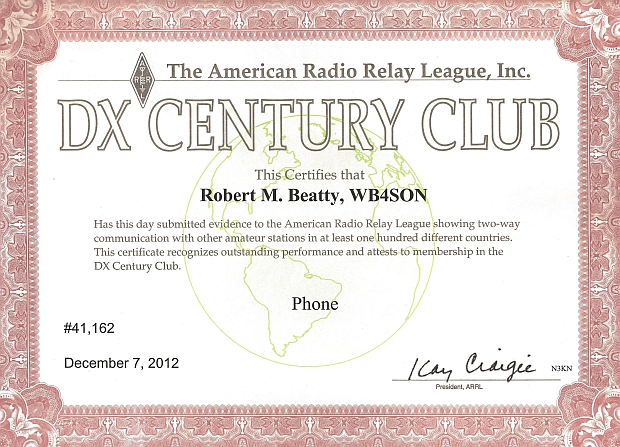
Yesterday, I received a nice certificate from the Northern California DX Foundation, which I joined earlier this year.  I’m so impressed with the work they do sponsoring DXpeditions, like PT0S.

Posted in DX, From the OM | Leave a comment

NBEMS – Narrow Band Digital Comm for EMS

I installed the latest version of FLDIGI, FLRIG, FLAMP, and FLWRAP on my Asus Netbook today for use with my IC-9100 on VHF.  I had used FLDIGI about 18 months ago to handle my first digital contacts with the Icom on HF, so I figured it would be an easy thing to get it running again.

Well the software had changed a bit (broken into multiple parts for different aspects), but it was easy to get installed and running.  I was already used to the craziness that comes with configuring a rig that has everything on a single USB connection (rig control, audio in and out).  I was pleasantly surprised to find that FLRIG, a CAT interface designed to work with many different rigs, was already setup for the IC-9100.  I dialed in my baud rate (19200), CI-V port address (60h), and selected COM3, which is the port where the Icom drivers installed the USB driver (making SURE to install the drivers BEFORE attaching the IC-9100).

The only issue I’ve noticed is there is no support in FLRIG for the FM Data mode (“D” Icon on the upper left corner of the screen).  So when FLRIG starts, it sets my 9100 to the regular FM mode (which means modulation comes from the MIC input on the front rather than the USB interface).  It is easy enough to press and hold the FM/AM button on the IC-9100 and get that “D” (data) icon back on the screen.

With the Icom menu #56 (USB MOD LEVEL) set to 27%, and menu #59 (DATA MOD) set to USB, the rig keyed up and transmitted tones without over driving the audio input of the rig (per a PSK IMD meter).

While the use of digital modes on a FM rig might seem odd, keep in mind that very few people have all mode (SSB) VHF equipment, or D-STAR capable rigs.  D-STAR itself has a built-in 1200 baud data channel that runs with the Digital Voice channel.  It provides about 5x the data rate as the fastest NBEMS mode (MT63-2000).  But there is some controversy over using D-STAR, which is perceived to be proprietary (even though it is not; it does rely on a commercial CODEC, which only one company makes due to lack of volume).  D-RATS software works with D-STAR radios to provide automated file delivery and keyboard chat services.

Now to drum up some support for NBEMS in the local area.

Posted in Digital Mode, ECOMM, From the OM | Leave a comment

How Strange!

I had the pleasure of working Eric, 5R8IC, on 15 meter CW late this morning.  Having never worked a station in Madagascar, I wanted to find out a bit more about the world’s 4th largest island, so I Googled it, expecting to find the Wiki entry at the top of the list.  Imagine my surprise when a link to the movie Madagascar came up in first place on Google.

Isn’t it strange that a cartoon would be more popular than the real place?

Posted in From the OM | Leave a comment

Another Sweepstakes “Clean Sweep”

With just a tad more than 6 hours to go, N8WSM from West Virginia completed my 2012 Phone Sweepstakes “Clean Sweep”.  He was my QSO #87 at 20:46:47 UTC.

It only took a few minutes to add a few more contacts to qualify for the participation award.  I stopped at 113 Qs.

Posted in From the OM | Leave a comment

And then there was one…

With 8 hours to go in the Phone Sweepstakes contest, I am now down to a single missing section, West Virginia (WV).  I heard NW8U several times on 80 and 15 meters, but very faintly.  Hopefully he will change to 80 or 40 meters later today.  None of the participants from last year’s Phone Sweepstakes seem to be on the air this time.

(Incidentally, Ontario North was one of my earliest contacts this time, and all of Canada was done by early this morning).

Posted in Contests, From the OM | Leave a comment

Phone Sweepstakes

With under 9 hours left in the Phone Sweepstakes contest, I am down to three remaining sections:  NLI (Northern Long Island), WV (West Virginia), and AK (Alaska).  I have heard a single station from West Virginia and three from Alaska earlier in the contest.  Northern Long Island appears to have a long list of participants, but I haven’t run across one yet.

Conditions are so poor that Alaska seems a long shot.  As for the other two, if they are get on 40 or 80 meters later today, they should be easy to work.

(Edited:  And 5 minutes after I posted the above, I worked a weak AL1G on 15 meters — What the heck do I know?)

Posted in Contests, From the OM | Leave a comment

Saint Peter and Saint Paul Archipelago, PT0S

In the hour before this weekend’s Sweepstakes, I was able to work PT0S (Saint Peter and Saint Paul Archipelago) on 30 meter CW.  I suspect that many avid DXers had already worked PT0S on all bands, and it probably helped that many hams were getting ready for the Phone Sweepstakes, but even still almost half of the 30 meter band was consumed with people replying to PT0S.  Fortunately the North-South path was strong and I was able to punch through the pile.

Later in the night, about 12:30 AM local time, I found a very loud PT0S calling CQ on 20 meter SSB.  They came back to my first call.  And a few hours later, about 3 AM local time they were VERY strong on 80 CW, but they were only working JA stations.  I have no doubt had they been working NA stations, I could have worked them again.

Ham Radio has been banned on the archipelago since the 1990’s, and special permits were required to allow this DXpedition to take place.  DX Magazine rates at #16 on their “Most Wanted DX List”

The Saint Peter and Saint Paul Archipelago is located at approximately 1 degree north latitude, 29 degrees west longitude.  It is claimed by Brazil, and is known as St. Peter and Paul Rocks.  As the photo below shows, it lives up to its name!

St. Peter and St. Paul Rocks

Posted in DX, From the OM | Leave a comment