Note to self…

So the bewitching hour has struck, and the capacity test continues on.

Testing high capacity batteries takes a lot of time.   Note to self for future tests:  Start earlier in the day!

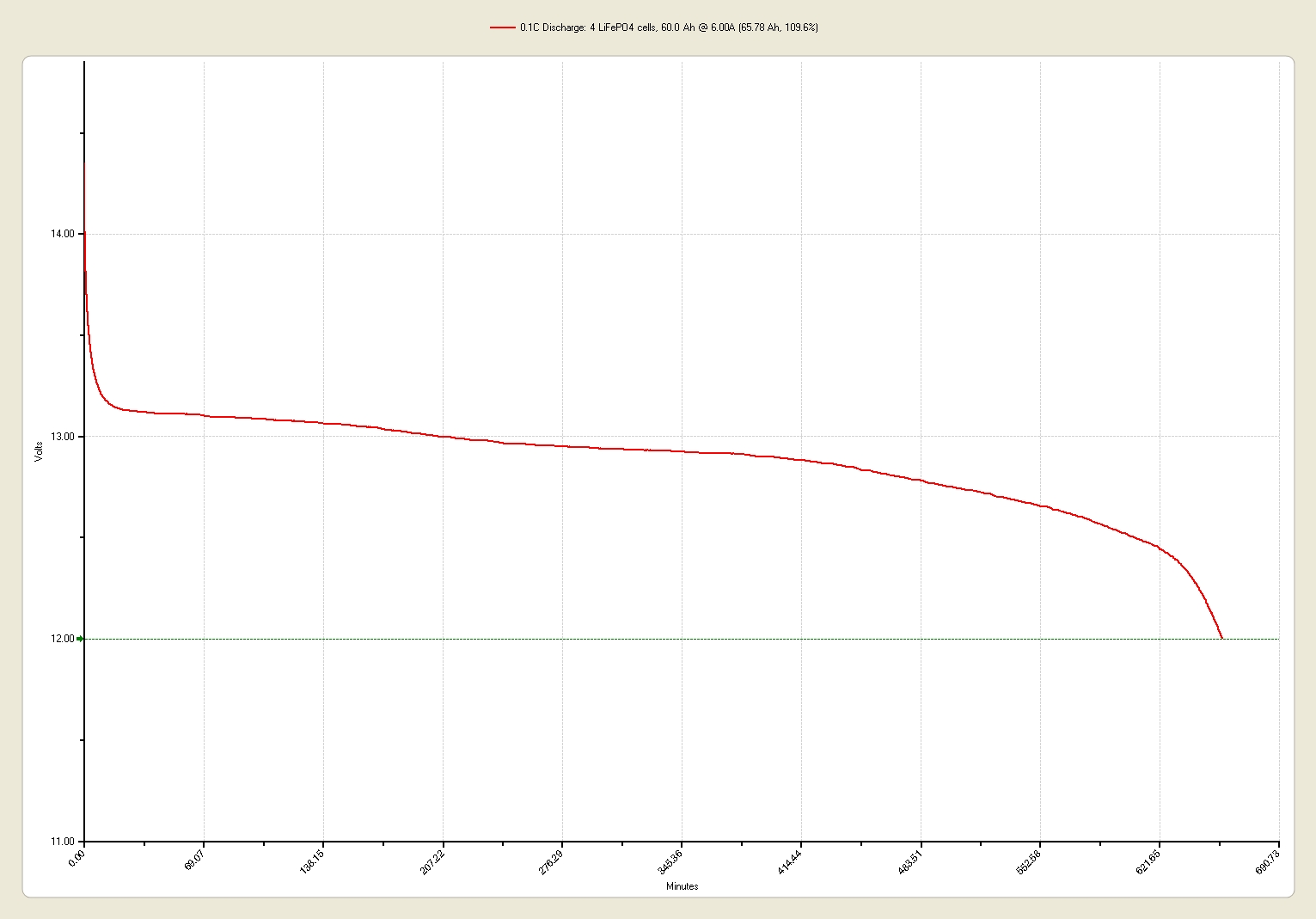
The 60AH battery has been under a 6 amp (C/10) load for 10 hrs 15 min and the voltage remains at 12.47 V.  I have the test termination defined as 12.00 V, a value substantially higher than the theoretical cutoff point.  In fact for a unbalanced 4-cell battery the recommended cutoff would be 11.2 volts and for a controlled discharge even lower.

Bottom line is the battery capacity will probably work out to be closer to 65 AH.

Posted in Alternative Power, From the OM, Gear | Leave a comment

60AH LiFePO4 Battery for Field Day

After monitoring my K3 power consumption during the SSB WPX Contest, I determined that I could run the K3 continuously set to full power in contest mode for about 30 hours with a 60 AH battery.  So my plan is to use a 60 AH battery to power one of the two FD stations this year.  The battery is charged by a 100 watt solar panel, so this will also count as an alternative credit as well, but even if the sun doesn’t shine, it should still operate the rig for the entire contest.

I had noted that the price of Prismatic LiFePO4 cells (commercial units used to fabricate heavy duty battery packs for EVs and other high current applications) had been falling substantially.  One company had individual cells that had fallen below my threshold of pain, and I was pleased to note that they actually sold set of four, pre-assembled, for even less.  So I purchased the set and a Power Control Module (PCM) to use with it.

PCMs come with various functions and ratings, and I acquired one that was rated for 30 amps of charge or discharge current (continuously).  In addition, it had full charge and discharge management based on a industry standard 8254 chip.  This works by monitoring the voltage of each individual cell and opening the charge path when the battery is fully charged, or by opening the discharge path if the battery is close to the minimum allowable voltage for any individual cell.  Seven large FETs are wired in parallel to control the current flow.  In addition a balance function makes sure that individual cells remain within +/- 25 millavolts of each other, and will control the flow of charge to individual cells to maintain balance.

Now a 60AH 13ish volt battery is nothing to sneeze at.  That’s over 750 watt-hours of energy stored in a small package.  If you think 2-slice toaster, you have a good idea of the volume, and it weighs about 20 pounds.  But a 60 AH LiFePO4 battery has an advantage of being able to use more than 90% of the stored charge with no damage to the battery.  So a 60 AH LiFePO4 battery is more useful than a 100 AH SLA, which can only be discharged to 50% unless you are willing to give up life.  Even though the PCM has a 100-150 amp short-circuit disconnect, I decided to add a conventional 25 Amp fuse to the positive lead, which is more than enough to support the full current drain of the K3/P3/KAT500.

The controller board lacks a decent mounting means, and even more surprisingly lacks a good solid mechanical mount for the many conductors that are needed for a high current device.  However I was still able to solder the equivalent of 10 AWG by using 4 individual Teflon 18 AWG wires.  (I chose Teflon for its abrasion resistance).  It will be sandwiched between sheets of vulcanized fiberboard

When it came time to attach the PCM to the battery, I covered all the battery terminals except the one I was working on with electrical tape.  I also covered the hex key as well, so only one tip was exposed.  (Years ago I worked on a Electric Vehicle and knew how much damage could happen if a tool were dropped while tightening battery connections.)  Eventually all the wires (11 of them plus the 10 AWG charge/discharge cable pair) and the battery caps were put back on.

When it came time to test, however, it appeared that the controller chip was keeping the discharge FETs open — I read no output voltage, despite the battery being at about 14.3 volts.  I hooked the battery up to my 6 Amp charger, and sure enough current was flowing into the battery, proving that the charge path FETs were conducting.  When I removed the charger, the discharge path was working as well.  That was enough to get the controller chip back in sync.

A quick 15 minute long discharge test at 10 amps showed a pretty characteristic LiFePO4 discharge curve — it quickly dropped from 14.3 volts down to about 13.5 volts, and took 15 minutes to reach the 13.0 volt point, at which point the curve had become very flat.  And this also gave me a chance to prove that there was no significant IR loss in the controller board or wiring, as the total voltage drop between battery terminals and load terminals was about 0.008 volts.

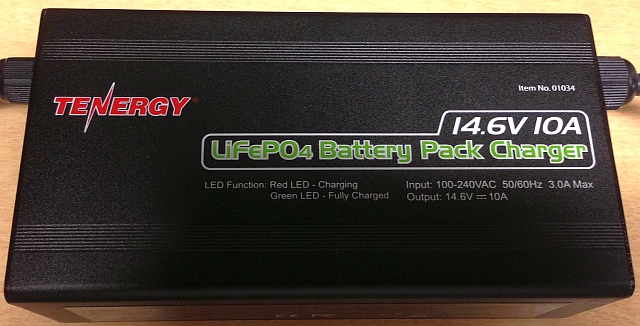
I then put the battery back on the charger and allowed it to run for several hours so the balance circuit would kick in.  When the charger was removed, all four cells were within 23 millivolts of each other (worst case).

Further testing will occur over the weekend, when I have the time to run a C/10 (6 Amp) test.  But given the initial discharge results, I suspect the battery will have little issue reaching its 60 AH rating.

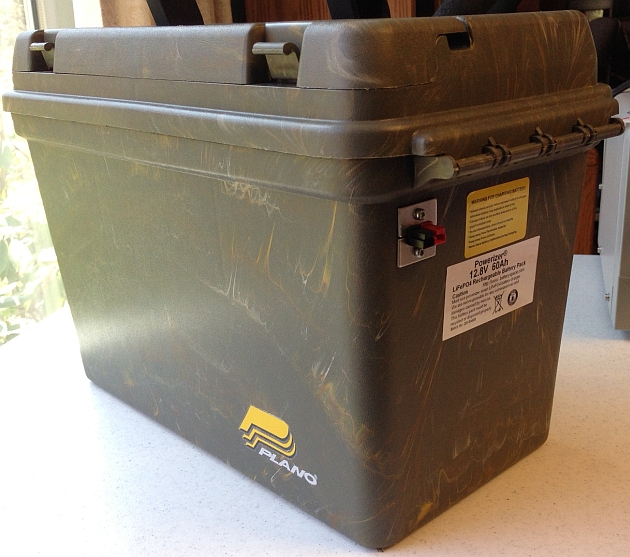
Basic 4S 60AH LiFePO4 Battery

Basic 4S 60AH LiFePO4 Battery

Power Control Module:  Prevents Overcharge, Undercharge, and Balances Batteries

Power Control Module: Prevents Overcharge, Undercharge, and Balances Batteries


PCM Attached to Battery for Initial Testing.

PCM Attached to Battery for Initial Testing.

Posted in Alternative Power, From the OM, History | 3 Comments

Patriot’s Day Bombing

I hesitate to write this, as it isn’t directly related to ham radio, but it did have an indirect impact as my technician class gladly stood down for a night as the Red Cross started their efforts to plan their response to the Patriot’s Day Bombing that happened 5 hours earlier and 70 miles to the north of us.  (The class is held in an American Red Cross facility)

I remind my wife and kids of this frequently, and by voicing it aloud, I remind myself.  We are VERY lucky to live in the United States.  Look to Israel, I say.  Almost daily a bus blows up, or bomb goes off. People die randomly, but life goes on. People still fall in love,  get married, have kids, go to soccer games, etc.  Life must go on. I tell my kids but for an accident of where they were born, they could be living in Africa and enduring unbelievable hardships — struggling daily against nature and man just to survive.  Even so, life MUST go on.

I am at the top of a long list of people that take the United States for granted. While I think we have been losing our liberty at an alarming rate since 9/11, becoming afraid of our own shadow, and spending trillions of dollars fighting an enemy that tries to break our will with a few dollars of chemicals, in truth we will never be entirely safe.  Random stuff happens. People die — we all die — it is part of life.  It is how we live that honors those who have died.  If we live in fear, we do a disservice to those who died getting us where we are today.

I believe the most valuable lesson from 9/11 is that America does have the resources to bring people to justice even a decade later, and we DO live on.  I hope that same tenacity is applied to this event.  I can’t help but notice the difference between 9/11 and 4/15/2013.  After 9/11 there was nothing but 24/7 TV coverage of the event for days.  Public events were closed nationally.  This time some TV was interrupted last night,  but it is back to showing soap operas today.  I’m not saying that’s a bad thing (life must go on, right, and getting back to routine is a great first step), but perhaps it is a sign of how jaded we’ve become in the past decade.  People say that the United States lost its innocence when President Kennedy was assassinated.  But I think we really lost our innocence on 9/11 after being isolated from the world’s ills for hundreds of years.

My thoughts and prayers go out to those families who lost loved ones or have suffered injuries, both physical and mental.  And I am, as always, grateful for those who stepped up and ran toward toward the sights and sounds of disaster, despite an almost overwhelming urge to run the other way.

Posted in From the OM | Leave a comment

Taking the exam for ARRL Volunteer Examiner

I took the ARRL-VEC Exam, which is an open-book 40-question yes/no, fill-in-the-blank, mini-essay type exam taking 3 pages.  Add a page long application and a copy of your license, plus postage for 2 ounces applied to the envelope, and the ARRL promises have credentials in your hands within three weeks.

The ARRL/VEC Volunteer Examiner Manual was revised this year, and it is available for free download from the ARRL.  It includes the application and test for becoming a volunteer Examiner.

While the book has been revised, the exam has not (it is dated 2011), and it sometimes shows its age (asking a question about who gets each of the three copies of a form that now has four copies, for example).  I would say that a third of the questions are obvious and simple to answer (especially those with simple yes/no response).  Another third can be answered with a few words, and are easy to find.  The final third tends to be obscure fine-level detail that is quite difficult to find in the manual.  A thorough and correct response might take a couple sentences (but rarely is there enough room for a complete/accurate answer).  This is not an example of a stellar exam, in my opinion, but I suspect that it may have been left somewhat obtuse to force the student to read every page of the manual.  Expect to spend about two hours completing the exam.

ARRL VEC Volunteer Examiner Patch

ARRL VEC Volunteer Examiner Patch

Posted in From the OM, Operating, Public Service | 3 Comments

Double-Peak For Cycle 24?

“Almost” as predicted, propagation is starting to get interesting.  The past few days have been outstanding with decent openings on 10 m and 12 m.  15-meters has been open the clock as well.  China, Vietnam, Thailand  South Korea, Indonesia, and the Philippians have become almost common place for New England hams.

I say “Almost” because the official prediction was for lower than normal activity with a standard single-peak happening about now.  With a decent spot-count and SFI in 2011, things took a turn for the worse in 2012 and early 2013, leading hams to think  Cycle 24 might be a disappointing thing of the past.  But as the movie below points out, the current thinking is that Cycle 24 will have twin peaks.  And a dual-peak cycle tends to stretch things out an additional year or two.

DoublePeak


Posted in DX | Tagged | Leave a comment

Honoring a Mentor

(Receiving John ‘s comment yesterday about his first QSO, reminded me that I needed to do something similar for mine)

I have misplaced my original license and logs (I will find them and put them online in eQSL and LotW someday), but I don’t need the log to remember my first QSO.  My father, had signed me up for a Huntsville Amateur Radio Club Novice Class in 1970, about the time I turned 13.  While I don’t remember much of the class, I can still see the instructor, Bob Gingras, WB4JMH, in my mind’s eye.  Bob had been an active member of HARC for years by then, and was brave enough to teach many of their Novice classes.  Back then the exams were longer, harder, and covered more theory, plus there was a requirement for 5 WPM Morse Code.  Bob worked very hard to get a pretty large group of us up to speed and trained before we took the Novice exam.  I believe you had to take the exam in a big city (Birmingham, Nashville, or Atlanta, for example), or sign-up for a traveling exam if you were lucky enough to have one in your area.  I think HARC had arranged for a traveling exam to happen during the annual Huntsville Hamfest.

Well, Bob did his job well, and a number of us passed the exam.  Sometime in the fall I finally received my license in the mail, and struggled for several weeks trying to make my first contact (using a military surplus ARC-5 receiver and 15 watt Ameco transmitter to an end-fed wire, probably about 50 feet long, that was stapled under to the soffit of our single-story house).  I wasn’t having any luck, and called Bob Gingras, my instructor, in desperation.  “Would he be willing to attempt a scheduled contact?” I asked, and he agreed.

Thus it came to pass, on Saturday October 21, 1970, at about 4:30 PM (the change to DST didn’t happen until October 25th, 1970), WB4JMH suffered through the trembling fist of WN4SON, becoming my first contact.  I called him, out of breath, a few minutes after our QSO to find out how things “really” went, and to confirm the few things I had managed to copy down between static crashes.  He laughed at my nervousness, mentioning that it was a difficult contact due to typical 80 meter noise during the daytime (made worse by my poor antenna and low power), but he assured me we really did make a contact, and a few days later I was handed a QSL card at the HARC meeting.

Bob Gingras, WB4JMH QSL card (My first QSO)

Bob Gingras, WB4JMH QSL card (My first QSO)

Bob Gingras, WB4JMH QSL card (My first QSO)

Bob Gingras, WB4JMH QSL card (My first QSO)

I always felt that Bob was my Elmer, and I think of him often.  The last I heard of Bob, he had retired and left Huntsville for Florida.  I heard he passed away some some years ago.  He might be gone, but his spark lives on in my memory.  In recognition of Bob, I’ve had my annual “brick” made with his name and call sign.  It will remain a memorial to Bob in the Diamond Terrace of the ARRL.

Posted in From the OM, History | Leave a comment

A QSL from the distant past…

I received a post-comment from John Boyd who mentioned that he recalled working a WN4SON back in the day.  While I’ve misplaced my log and original license (I know they are packed in a box from one of my moves), I have never lost track of my QSL file box.  Sure enough, I found John’s QSL card, which I’ve scanned to share:

WN4UFJ QSL from 1971 (front)

WN4UFJ QSL from 1971 (front)

WN4UFJ QSL from 1971 (back)

WN4UFJ QSL from 1971 (back)

This was a card confirming John’s first contact as a Novice.  (My first QSO had happened just a couple of months prior.  Back then my log was full of “Called CQ, no response”, or “Called WN4XYZ, no answer” entries, so I probably didn’t have a large number of contacts under my belt either.  Note the Home Brew transmitter with 35 watts of input power (back then very few people had the capability of measuring SWR, let alone output power).  And the 5 cent stamp catches my eye too!

This is the second time that I’ve run across a ham friend from the past.  When I started these blog ramblings a couple of years ago, I never would have guessed that others might stumble across them.  But it happens, and when it does, it is like opening a window to the sights and sounds of a simpler time that created many fond memories.

Sure enough, John and I both managed to upgrade our license and both are still active as hams today, 42 years later.

Posted in From the OM, History | Leave a comment

Class Begins…I pity the students

I’m teaching a Technician Class on behalf of the Newport County Radio Club, and the first class begins tonight.

Over the years I’ve taught many classes in various different subjects (micro-controller applications, celestial navigation, boy scout merit badges, boating safety, etc.) .  But this is the first time I’ve taught a ham radio related class.

I surprised myself by selecting a Gordon West book as the basis for the course over the ARRL material.  Both texts are approximately $20, but Gordon has organized his book into 20 topics that cover all 10 exam areas, and has integrated each of the 394 questions into the book; organizing them in a way that doesn’t involve flipping around from section to section.

Its hard to project back 43 years to when I was taking my Novice class.  I do know the exam was longer and covered much more electrical theory, plus it had a 5 WPM code requirement.  Today’s test is only 35 questions, out of a pool of 394 questions; all of which have been published.  In terms of theory, ohm’s law and the power equation are the only thing involving math and there are only 4 questions related to that.  It seems almost impossible to fail, but of course, after 43 years of ham radio, it should seem easy, right?

In reality there are 701 power-point slides to cover in 10 hours of instructions.  It is a lot of material to go through each class for sure.  But with a decent book, and online resources like the eHam.net Exams, it should be pretty simple for anyone to pass even with my dubious instruction.

Posted in From the OM, Instruction, Public Service | Leave a comment

XT2TT Confirmation completes TWO goals for 2013

I just received LotW confirmations from XT2TT, Burkina Faso, that included a RTTY digital contact.  That confirmation actually completes my first goal for the year; getting 175 countries confirmed in LotW.  It also completes a second goal; getting Digital DXCC and completing a hat-trick (CW/Phone/Digital DXCC).

So I suppose my first goal wasn’t difficult enough.  I had 154 confirmed countries in LotW at the end of 2012, so I’ve added 21 new ones.  Shooting for 200 confirmed in LotW seemed like too large a leap (46 new ones), given the rate that I find new countries.  Still, guess I have to set a new goal of 200 by the end of 2013.

And how I wish the ARRL had a “Triple Play” for DXCC like they do for WAS (CW/Phone/Digital WAS).  But, alas they don’t.  Still, its a good feeling to know that I’ve completed that goal.

So what’s left? 5BWAS, 5BDXCC.  I’m 3/5 of the way to both of those.

Posted in DX, From the OM, Operating | Leave a comment

15-Meter WAS: Thanks Steven, W3SFG

In the march toward 5BWAS, 15-meters was crossed off the list this morning when W3SFG, Steven in Maryland, confirmed our contact made 10 days prior.

I had been watching LotW closely, waiting for that contact to be confirmed, and became concerned when I saw his most recent upload did not include a confirmation.  I took a scatter shot at guessing Steven’s email, and was fortunately able to get through to him.  Our QSO was in his log but was not in LotW despite the recent upload.  To make a long story short, it turned out he had logged the mode as “JT65A” (technically correct), but LotW’s eQSL program was rejecting entries with that emission type (only accepting the more generic base mode “JT65”).

When I suggested this might be the issue, Steven noticed that he hadn’t received a single JT65A confirmation since December, when he had switched to a different computer.  I further suggested that a more recent TQSL Configuration File (1.19:  You can find it HERE) would accept JT65A and automatically convert it to JT65.  Apparently that did the trick, and Steven was able to upload his TQSL file again, and this time the JT65 confirmation went through.

Whew — Three down and two to go for 5BWAS.  Only AK needed for 80-meter WAS.  But 15 states needed for 10-meter WAS.  I bet you can guess which band my rig will be on this summer!


Posted in From the OM, LotW, Operating | Leave a comment