GoKit Phase 1 – A long time coming

After participating in a multi-agency shelter communication drill this past weekend (which went quite well), I decided it was time to dust off my GoKit components.  I had originally intended to make a VHF-only kit using a Yaesu FT-2900R, then thought about moving to an all-band/mode Icom IC-7000 solution.  But I figure that my original plan was still the best, so I finally mounted the Rig to my Samlex SEC-1223BBM power supply — heck I had waited so long that the warranty had expired with the rig and supply still in the box, so drilling holes in the power supply cover to put on the mounting bracket for the rig was no longer an issue.  Fortunately, everything worked, and now I have a nice emergency rig that can comply with my state Red Cross Shelter ICS-205 Communication Plan.  And to top it off, the Samlex has an automatic battery backup transfer function and charger ideal for use with a LiFePO4 “SLA Drop-in Replacement”.

On bench-test, into a dummy load, the FT-2900R puts out 5/11/38/81 watts at 4.4/5.7/8.9/14.5 Amps (@ 13.8 VDC).  RX draw with the backlight on is 0.3 Amps when squelched.

I do like the Alphanumeric display, but the traditional RX/TX Frequency Display is just a button push away.

FT-2900R and SEC-1223BBM Mated Together for GoKit

FT-2900R and SEC-1223BBM Mated Together for GoKit

Posted in From the OM, Gear, Public Service | Leave a comment

Operating W1AW/1 RI

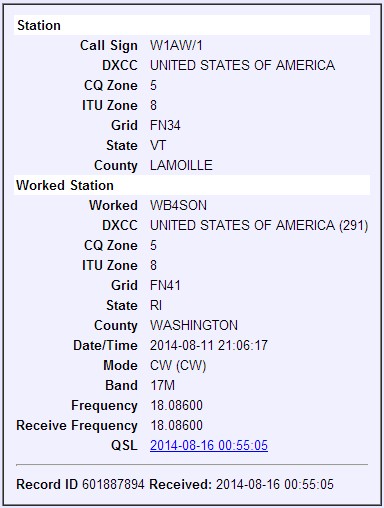
Today (yesterday, actually) was the big day, and at 8 PM local time, the first RI stations were on the air operating as Centennial station W1AW/1 in Rhode Island.  From 8 PM until my time slot at 10 PM, I concentrated on working 3 RI stations and 3 Indiana stations (the other state on the air this week).  Before I knew it, it was a couple of minutes before 10 PM, and my timeslot for 80 Meter CW was coming up.  I listened to the 8-10 PM op sign off the air, and with butterflies in my stomach I picked up right where he left off (same frequency).

I’d like to be able to brag and say that I did some sort of fantastic job.  I really didn’t.  After two hours of straining to hear a call in the pile-up, I had worked 152 stations in 8 countries.  Probably about half of what I should have been able to do and maybe a quarter of what an expert op would do.  For example, I know the 40 meter CW operator reported about 250 Qs from 8 PM until 10 PM.

To be sure, I was having issues with the N1MM kicking out of run-mode every time I changed my RX frequency more than a few hundred hertz to restart the gradual pile scan.  Of course I didn’t want to stop in the middle of doing things to figure out why.  But the macros for S&P are VERY different from those used in Run-Mode, so that would trip me up.  Eventually I figured out that operating in a pile-up like that requires you to configure N1MM in S&P mode (or at least that’s all I could figure out).  Good news is I am all set for the next time.

Anyway, the truth of the matter is I can’t blame anything other than what’s between the headphones — me.  I’m just not that good at picking calls out of a huge pileup.  I have new found respect for the operators that can do that and do it so effortlessly.

W1AW/1 Pileups Hurt My Tiny Wombat Ears!!!

W1AW/1 Pileups Hurt My Tiny Wombat Ears!!!

Posted in Contests, Operating | 2 Comments

Bye Bye Solar Cycle 24 ?!?

Sad but true, as of today, July 16, 2014, the sun is spotless.  The last time that happened was on August 11, 2011.  SolarHam.com even compared the spotless sun to an orange today!

ssn_predict_l

You can clearly see the double peak of Cycle 24 on the graph above.  Unless there is another outburst, it looks like the peak smoothed sunspot number of 75.4 was reached during November 2013, which was a first for solar observations (having the second peak larger than the first — the first being 66.9 in Februrary of 2012).

Cycle 24 remains the weakest solar cycle since Cycle 14 in 1906.  By the way, the expectation for the peak of Cycle 25, a decade in the future, is even lower than Cycle 24.

Time for 80 Meter DXing!

Posted in Digital Mode, DX, Operating, Propagation | Leave a comment

Field Day 2014 Satellite Passes

This is a list of satellite passes that occur between 1400 Local on Saturday June 28 and 1400 Local on Sunday June 29 for the Rhode Island (FN41) area is shown below.  AO-7 will only be usable during daylight hours.  AO-73 should be usable at any time on the weekend, but its possible that it might only be available when eclipsed).

AO-07 Operating Mode (Could be in Mode A: 2m Up/10m Down)

  • Uplink: 432.1250 – 432.1750 MHz SSB/CW  (LSB)
  • Downlink: 145.9750 – 145.9250 MHz SSB/CW  (USB)

AO-73 Operating Mode U/V

  • Uplink: 435.150 – 435.130 MHz  (LSB)
  • Downlink: 145.950 – 145.970 MHz  (USB)
  • Beacon: 145.935 MHz BPSK Telemetry

FO-29 Operating Mode J (V/U)

  • Uplink: 145.9000 – 146.0000 MHz SSB/CW  (LSB)
  • Downlink: 435.8000 – 435.9000 MHz SSB/CW  (USB)
  • Beacon: 435.7950 MHz CW

VO-52 Operating Mode

  • Uplink: 435.2250 – 435.2750 MHz SSB/CW  (LSB)
  • Downlink 145.9250 – 145.8750 MHz SSB/CW  (USB)
  • Beacon: 145.8600 MHz CW

Field Day 2014 Passes for Rhode Island:

AO-07    6/28/2014     2:39:17 PM 2:59:58 PM 00:20:41      54.8° 28.3°
FO-29    6/28/2014     3:50:26 PM 4:03:38 PM 00:13:12      43.9° 7.8°
AO-07    6/28/2014     4:30:10 PM 4:53:20 PM 00:23:10      254.3° 71.9°
VO-52    6/28/2014     5:04:56 PM 5:16:56 PM 00:12:00      67.5° 21.4°
FO-29    6/28/2014     5:30:11 PM 5:50:09 PM 00:19:58      64.4° 39.9°
AO-07    6/28/2014     6:27:07 PM 6:44:42 PM 00:17:35       273.2° 12.7°
VO-52    6/28/2014     6:40:17 PM 6:53:10 PM 00:12:53       263.7° 33.1°
FO-29    6/28/2014     7:14:58 PM 7:35:17 PM 00:20:19        264.8° 44.3°
AO-73    6/28/2014     8:13:20 PM 8:19:02 PM 00:05:42      52.4° 2.2°
FO-29    6/28/2014     9:06:12 PM 9:17:29 PM 00:11:17       284.1° 4.8°
AO-73    6/28/2014     9:44:29 PM 9:58:04 PM 00:13:35      69.8° 34.8°
AO-73    6/28/2014     11:21:09 PM 11:34:19 PM 00:13:10   265.6° 23.7°

AO-07    6/29/2014     2:42:50 AM 2:52:30 AM 00:09:40    78.9° 2.7°
AO-07    6/29/2014     4:31:33 AM 4:53:52 AM 00:22:19     99.0° 39.9°
FO-29    6/29/2014     4:43:44 AM 4:50:35 AM 00:06:51     72.6° 1.6°
VO-52    6/29/2014     4:54:07 AM 4:56:03 AM 00:01:56     81.7° 0.2°
FO-29    6/29/2014     6:24:22 AM 6:43:56 AM 00:19:34     92.2° 34.7°
AO-07    6/29/2014     6:24:25 AM 6:46:48 AM 00:22:23     296.5° 48.4°
VO-52    6/29/2014     6:25:38 AM 6:38:33 AM 00:12:55     97.4° 39.6°
VO-52    6/29/2014     8:02:02 AM 8:13:32 AM 00:11:30     293.9° 17.7°
FO-29    6/29/2014     8:09:17 AM 8:29:24 AM 00:20:07     291.9° 48.6°
AO-07    6/29/2014     8:18:21 AM 8:34:25 AM 00:16:04     319.1° 11.2°
AO-73    6/29/2014     9:35:25 AM 9:43:23 AM 00:07:58     84.5° 4.8°
FO-29    6/29/2014     9:55:35 AM 10:09:56 AM 00:14:21    313.5° 10.1°
AO-73    6/29/2014     11:09:49 AM 11:23:18 AM 00:13:29   100.7° 69.9°
AO-07    6/29/2014     12:00:51 PM 12:03:49 PM 00:02:58   16.4° 0.3°
AO-73    6/29/2014     12:47:07 PM 12:57:42 PM 00:10:35   298.6° 11.6°
AO-07    6/29/2014     1:42:34 PM 1:59:27 PM 00:16:53        43.0° 13.0°

Posted in Contests, From the OM, Operating, Satellite | 2 Comments

Heatsink “Accessory” for KX3

I love my 2-year old KX3, simply the best all mode QRP portable rig I’ve ever used.  The popularity of the radio is evidenced by an ever-growing marketplace providing accessories.  Due to thermal issues experienced by those running digital modes with the KX3, accessory heatsinks have started appearing from several vendors.  After evaluating three different designs, I chose the PAE-Kx31 Heatsink by Pro Audio Engineering.

While I was unlucky enough to hit a period of time when they were out of stock, the wait was well worth it, as I was very impressed with the product when it arrived yesterday.  There were no rough or sharp edges, the entire heatsink was nicely finished and black anodized to match the appearance of the KX3.  The instructions offered three installation methods from laughably simple, to slightly more complex.  I chose the most complex for performance reasons, and the entire modification involved removing 4 screws, 2 nuts, and took about 15 minutes — 98% of which was scraping some of the powder-coat off the original KX3 enclosure for better heat transfer (covered by either the original heat plate should you decide to put it back, or the new heatsink).

I’m anxious to try this with JT9, which has been impossible to use in the past due to thermal drift (despite trying the enhanced thermal calibration multiple times).  See below the photograph for thermal results.

Here is a photograph of the installed product.  Note that it is 100% compatible with my favorite accessory, the GEMS Products Side KX side plates and cover.

PAE-Kx31 Heatsink Installed on KX3 #0091

PAE-Kx31 Heatsink Installed on KX3 #0091

Edited:  During a cycle of ten 1 minute on and 1 minute off tests at 5.0 watts, the PA reached a max of 36C during transmit, while the oscillator probe was at 37C.  It would fall back down during the off interval to PA=30C and Osc=35C.  Similar tests run at 10.0 watts, showed a maximum PA=50C and OSc=44C.  During the 1 min off interval, the temperature would be PA=35C and Osc=36C.  These tests were done at 22C ambient.

Prior to the modification, at 5 watts output, the PA temperature would rise into the mid-60C range, in less than a minute, then cause a high temp trip at 5 watts.  I could never get more than 3 watts out for long duration transmissions.

Posted in Digital Mode, Gear, JT65A-HF, JT9, QRP | 8 Comments

Capacity Test Results for Bioenno 30AH 12V LiFePO4

I finally had a chance to run a test on my Bioenno Power FL4S10PHCC 30 AH, 12 V, LiFePO4 battery this weekend.  I would normally do my testing at a C/2 rate, or 15 Amps in this case, but that exceeds the 10 amp capacity of my test equipment.  So I settled on a C/4 rate of 7.5 Amps. The battery was given a full charge cycle after being received new from the factory, then subject to a 7.5 Amp constant-current discharge until it reached a terminal voltage of 10.0 volts.  The results indicated a measured capacity of 29.88 AH, very close to the nameplate capacity.  Here is the test graph:

Bioenno Power FL4S10PHCC LiFePO4 battery discharge curve at 7.5 amps

Bioenno Power FL4S10PHCC LiFePO4 battery discharge curve at 7.5 amps

The battery remained above 12.0 volts for 228 minutes (95% of nameplate capacity), then remained above 10.0 volts for the next 10 minutes.


Posted in Alternative Power | 15 Comments

Update on 3 Year Old LiFePO4 Battery

Executive summary – Even a properly maintained (periodically charged) LiFePO4 battery should be undergo a charge/discharge/charge cycle to maximize performance after long periods of idle time.

I’ve had a few entries concerning my original LiFePO4 battery, a 9.6AH  K2-Energy pack with built-in battery management.  I’m mostly using larger batteries now, but still use that pack for QRP operation, and I ran my IC-9100 with it last Field Day to make several satellite contacts.  So after Field Day, I charged it up, then recharged it in December, and finally again yesterday.

LiFePO4 Battery (12V, 10AH, 2.5Lbs)

K2B12V10EB LiFePO4 Battery (12V, 10AH, 2.5Lb)

Since the battery now had 3 years I felt it would be a good time to retest the capacity.  I ran the identical 4.8 Amp constant-current discharge, and found that the battery had a usable capacity of 9.0 AH.  Not bad for something that is 3 years old, basically 94% of its original nameplate capacity.  However, since I had not used the battery in essentially a year, I wanted to recharge it and test it again.

Within minutes of the test starting, I could that things had improved.  The battery voltage which had decayed quickly to about 12.4 volts after that discharge test yesterday, was now closer to 12.8 volts.  While the 12.0 volt mark was reached after 7.14 AH yesterday, it was reached at 8.30 AH today.  The final capacity was 9.00 AH yesterday, and 9.14 AH today.   This compares very favorably to the capacity tested a bit over a year ago, of 9.22 AH.

Clearly this charge/discharge/charge process had restored some of the “missing” capacity

After 3+ Years 95.3% of nameplate capacity remains.

After 3+ Years 95.3% of nameplate capacity remains.


Posted in Alternative Power | 6 Comments

Update on 60AH LiFePO4 Battery

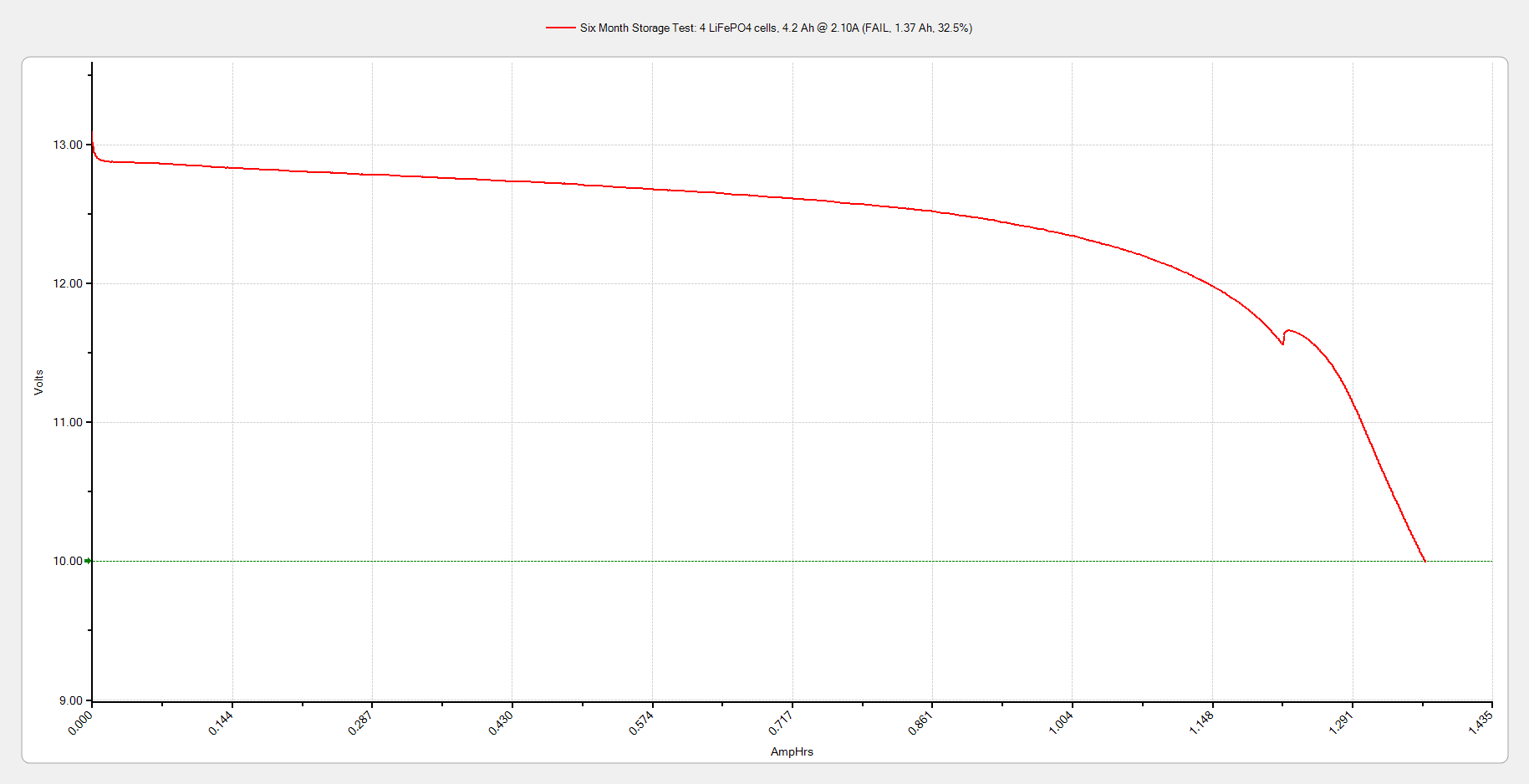
About a year ago, I assembled a 60 AH 12V LiFePO4 battery to run the GOTA station during field day.  The battery was stored fully charged after field day then recharged on December 14.  I just took it out of storage today, 135 days later.  In that period of time, the battery lost 0.351 AH of its capacity, or approximately 0.6% over 4 months (based on the amount of energy put back into the battery to reach charge cutoff at 14.6 volts).

60AH Battery Pack in a box

60AH Battery Pack in a box

Since the battery is now a year old, I will run a full capacity test again.  When I ran the capacity test a year ago, it actually had a 65.7 AH measured capacity (6.0 Discharge current with the test stopping at 12.0 volts).

Posted in Alternative Power | Leave a comment

I’m a Sucker For a New Key

Within moments of the email from the ARRL hitting my inbox several months ago, I had ordered a Vibroplex ARRL 100th Commemorative Iambic Paddle.  Serial number 213 arrived today, with WB4SON engraved into the base.  Guess this is a key that won’t be resold anytime soon.

ARRL 100th Anniversary Key (WB4SON #213)

ARRL 100th Anniversary Key (WB4SON #213)

Posted in From the OM | Leave a comment

Cute Card From Coventry Technician Class

I had an opportunity to teach a Technician class to a wonderful group of folks from Coventry and West Warwick, who were EOC, Shelter, and CERT volunteers.  We held the usual 6-week Technician Class every Wednesday (dodging snow storms), and 14 of them took their exam on April 16th.  All 14 passed, as I was hoping.  Congratulations to all of them!!

A few days later I received a VERY cute note in the mail from my students.  It was greatly appreciated.  I’ve copied it below:

ThankYouNote

Posted in From the OM, Instruction | Leave a comment