Second Charge Doesn’t Fix Zippy – Capacity 77%/3.2 AH

A second charge cycle didn’t have much of an impact on the Zippy battery.  It showed a capacity of 76.7%, which is still considered failing (< 80% of rated capacity).  I carefully monitored the charge process, and couldn’t help but notice it was cutting off after 3.3 AH of charge had been put into the battery.  It simply is no longer taking a 4.2 AH charge.

I’ve never felt very comfortable about the Zippy battery, which has not performed like other LiFePO4 batteries I’ve tested.  Perhaps the 18 months of sitting (despite the fact that all individual cells were sitting between 3.15 and 3.35 volts) damaged the battery, or this is simply a slow degredation of capacity, I don’t know.  The battery is still useful and performs well but at a reduced capacity.

Second Charge/Discharge Cycle after 18 months of storage.  3.2AH (77%)

Second Charge/Discharge Cycle after 18 months of storage. 3.2AH (77%)

Posted in Alternative Power | 4 Comments

Zippy Charge #1 After 18 Month Storage – 3 AH (73%)

After testing the remaining capacity following 18 months of storage, The Zippy battery was recharged, remained idle overnight, then retested under a 2.1 Amp load.  The capacity was up to 72.5% (3.0 AH), which is considered “failed” (less than 80% of rated capacity).

First charge/discharge cycle after prolonged storage (18 months)

First charge/discharge cycle after prolonged storage (18 months)

Past experience has shown that doing a second charge cycle after prolonged storage will further increase the capacity.  We shall see.

Posted in Alternative Power | Leave a comment

Zippy Battery Capacity Test After Eighteen Months of Storage

I had an opportunity to let my 4.2 AH Zippy battery sit unused after I last charged it on February 26 of 2013 — that was eighteen months ago.

I had noted in earlier testing that the Zippy self-discharge seemed to be about 2X higher than other LiFePO4 batteries I’ve tested in the past, but speculated that the self-discharge rate might calm down after time.  But as my most recent test illustrates, the self-discharge stayed about the same — 3.8% per month.  At the end of eighteen months, the Zippy battery still had 1.3 AH remaining.  That’s 32.5% of its original capacity, or a loss of 67.5% (3.8% per month).

Battery test @ 2.1 Amp Discharge (C/2) following six months of storage.

Battery test @ 2.1 Amp Discharge (C/2) following eighteen months of storage (graph incorrectly labeled “Six” months).

NOTE:  The graph above is incorrectly labeled.  While it says “Six Months” in reality it was 18 months of storage (since Feb 2013).  And even though the battery is marked as “Failed”, note that it was still above 13 Volts after 18 months of storage, and still had 33% of its original capacity.  While not as good as a primary Lithium battery (15-20 years of storage life), being able to set a battery aside and ignore it for 18 months is still pretty impressive.  Do that with a SLA battery and it will be totally dead and won’t recover.

Posted in Alternative Power, From the OM | Leave a comment

Julian Plowright, N1UNP, Silent Key

A dear radio buddy, Julian Plowright, N1UHP, passed away last night.  Julian was quite active in my club (Newport County Radio Club).  He participated in our Field Day activities, most recently upgrading to Extra Class prior to this year’s event.  Julian participated in other on-air events, and most recently obtained permission from all the various parties involved with our Goat Island activation.  Although his health declined quickly, and he could no longer get on the air, he was aware of the success of the event.

Julian, I miss you already.

Embedded image permalink

Julian Plowright, N1UHP, at the NCRC Field Day, June 2014

Posted in From the OM | Leave a comment

Sixth Band Completed on WAS

W1AW/1 worked out to be the final QSL needed to finish 17 Meter WAS, completing WAS on six bands (80/40/20/17/15/10 meters).  Still have a bunch of work to get to 9BWAS:  8 more needed on 12 meters, 3 more on 30 meters, and 13 more on 160 meters.

VT-17m

Posted in From the OM, Operating | Leave a comment

An Autonomous Automatic Satellite Tracker for a Small Crossed Beam

One of the goals I set for 2014 was to develop an antenna tracker that would be fully self-contained and not require an interface to a PC to obtain the tracking coordinates.

The major components of the project are:

  • Raspberry Pi – responsible for all computations and data storage (satellite ephemeris)
  • Human Interface – small LCD that will show useful information (Lat/Lon/TOD, Selected Satellite, Az/El infomation, etc.)
  • Mechanical System – the support for the antenna and servos for position control
  • Interface Electronics – the jellybean electronics to drive the servo motors, provide power, and support the user interface.
  • GPS – A GPS receiver that will be used to obtain the current location (lat/lon/altitude), as well as the current time of day.
  • Antenna – Small array suitable for LEO Satellite Operation.

I’ve selected a Raspberry Pi, which has the computational capabilities necessary to calculate the Az/El data in real time, plus has wonderful build-in facilities for time keeping, and obtaining the ephemeris data from the internet (periodically power the device up and either connect to WiFi or the built-in Ethernet interface and automatically obtain the most current TLE data from the web).

The Human Interface will be a small LCD with push-buttons, all obtained (along with the Raspberry Pi) from Adafruit.com.

The antenna itself will be an Arrow Antenna 146/437-10 portable crossed beam which has worked very well for several Field Day operations.  See (http://www.arrowantennas.com/arrowii/146-437.html)

All of the above is stuff that I’ve used many times in the past (such as the NTP Station Clock based on the Raspberry Pi.  The stumper for me has always been the mechanical items:  Servos, actuators, etc.  I did some work with an Arduino last winter and discovered how easy it was to control Servos, so that left the mechanical aspect to work out.

When working with the Arduino, I uncovered servo-nervana when I stumbled upon ServoCity (http://www.servocity.com).  They offer a very cool servo from Hitec (HS-785HB), which is pretty unique in that it can do about 400 degrees of rotation (most servos are limited to 180 degrees of motion).   A pair of these servos, one for the Az and one for the El axis, provide the motion control.

Servo

But there is still the issue of all the mechanical stuff — the arms, fittings, bearings, etc.  So I’ve decided to make use of another ServoCity device: The PT785-S Pan and Tilt System (http://www.servocity.com/html/pt785-s_pan___tilt_system.html#.U-5jC_ldV8F).  This is a complete assembly — I will mount it to a tripod, and then mount the Arrow Antenna onto the pan/tilt arm:

PT785S

I’m in the process of obtaining the parts now, and when the fall/winter comes, I’ll tackle the software.  Should be fun!


Posted in Raspberry Pi, Satellite, Tracker | 2 Comments

Six Band WAS?

I have been missing only Vermont for 17 Meter WAS, which would be WAS on 6 bands.  Today I finally heard Vermont in the form of W1AW/1 running CW.  Very hard copy and a great OP on the other end who stuck with it and dug it out.  Now to wait for the confirmation!

W1AW VT CW QSO

Posted in LotW, Operating | Leave a comment

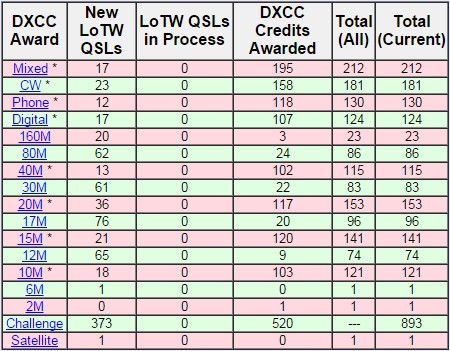
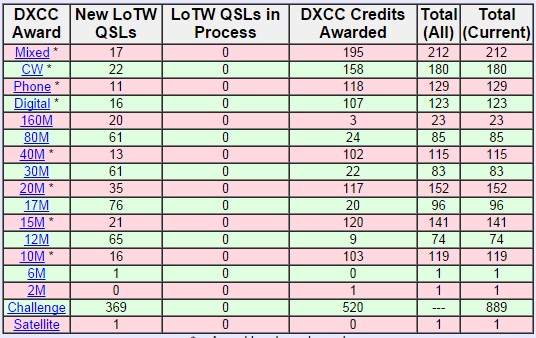
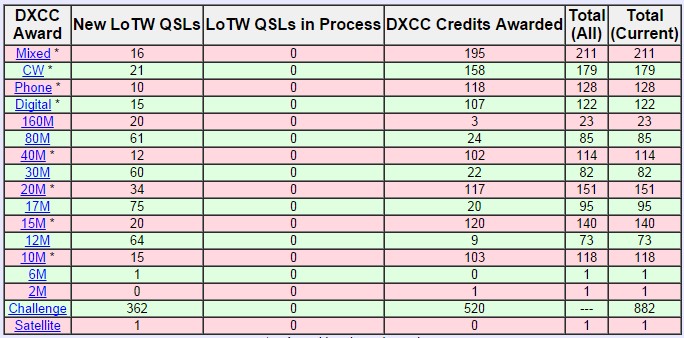
DXCC Update: 210 Confirmed, 870 Challenge Points

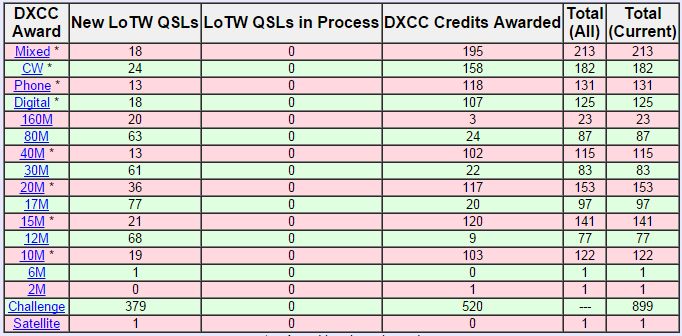
I dropped off a number of QSL cards that confirmed new countries, or band/mode contacts to the card checkers during the Centennial Convention.  While it took under 5 minutes at the Convention, the Online Application still needed to be processed by the DXCC Desk.  That process was completed a few days ago.  Now I have 210 Confirmed Countries, 17 more to go on 80 meters to complete 5BDXCC, and 870 Challenge Points.  It looks like I am pretty close on 17 meters too, with 8 more confirmations needed.

LOTW Aug 10 2014

Posted in DX | Leave a comment

Congratulations Team RI for Outstanding W1AW/1 Results

Team RI, managed by John, W1XX, of the CTRI Contest Group, posted a final QSO tally of 38,342 QSOs.  This puts RI in 11th place nationally, behind some huge large ham population states like PA and NJ.  That said we still completed more QSOs than states with many many times the ham population (like NY, TX, or CA), so we have a lot to be proud of.

A total of 16 different stations were on the air, including your’s truly.  Several of these were large multi-op stations, including KI1G, which completed 17,203 QSOs (more than five entire states).

RI will be back on the air during the November Phone SS Contest too.

Posted in Contests, Operating | Leave a comment

A QSO with Joe Taylor, K1JT

So ever since I re-entered radio in 2011, and heard the strange (to me then) tones of JT65 on 80 meters, I’ve been hooked.  That mode, and JT9 that followed, enabled me to make WAS in a month on the air, and DXCC within a couple of months, all while running 5 watts QRP to a horrible end-fed antenna stapled to trees during a snowy February.

In the three years since, I’ve reentered the hobby with new found energy, making literally thousands of contacts and participating in many ways.  But one thing has been high on my list — getting a chance to have a QSO with Joe Taylor, K1JT, inventor of JT65, Astrophysicist and Nobel Prize winner.  (I really enjoyed hearing his lunch-time speech during the ARRL Centennial Convention).  Today my wish came true on 20 meters during a JT9 QSO.  Joe was nice enough to respond to my call.

Screen-cap QSO with Joe Taylor, K1JT using JT9 on July 31, 2014

Screen-cap QSO with Joe Taylor, K1JT using JT9 on July 31, 2014

Posted in Digital Mode, From the OM | 2 Comments