I wasn’t sure if the Pebble HF design was tested for harmonic output prior to the reduction in turns on toroid LX1 (original was 10 turns, now 9 turns). So I figured that was a good excuse to dust off my Siglent SSA-3021X Signal Analyzer to see how my specific Pebble was doing.
My Pebble puts out close to 6 watts at 14 volts, so the first task was to pick a set of attenuators that would put its output well below the 30 dBm input limit of the analyzer. I started with a 6dB attenuator rated at 10 watts, then added in another 30dB attenuator rated at 5 watts. That was a total attenuation of 36 dB. I then verified that this was the actual attenuation by using the Tracking generator – sure enough the attenuators were up to spec.
Next up it was time to check out the harmonics. I set the analyzer to start at 5 MHz and go up to 50 MHz (enough to catch the 2nd, 3rd, ant 4th harmonic of 14 MHz). The Pebble fed the 36 dB attenuator, which was connected into the analyzer RF input. The built-in straight key made it easy to generate the carrier.
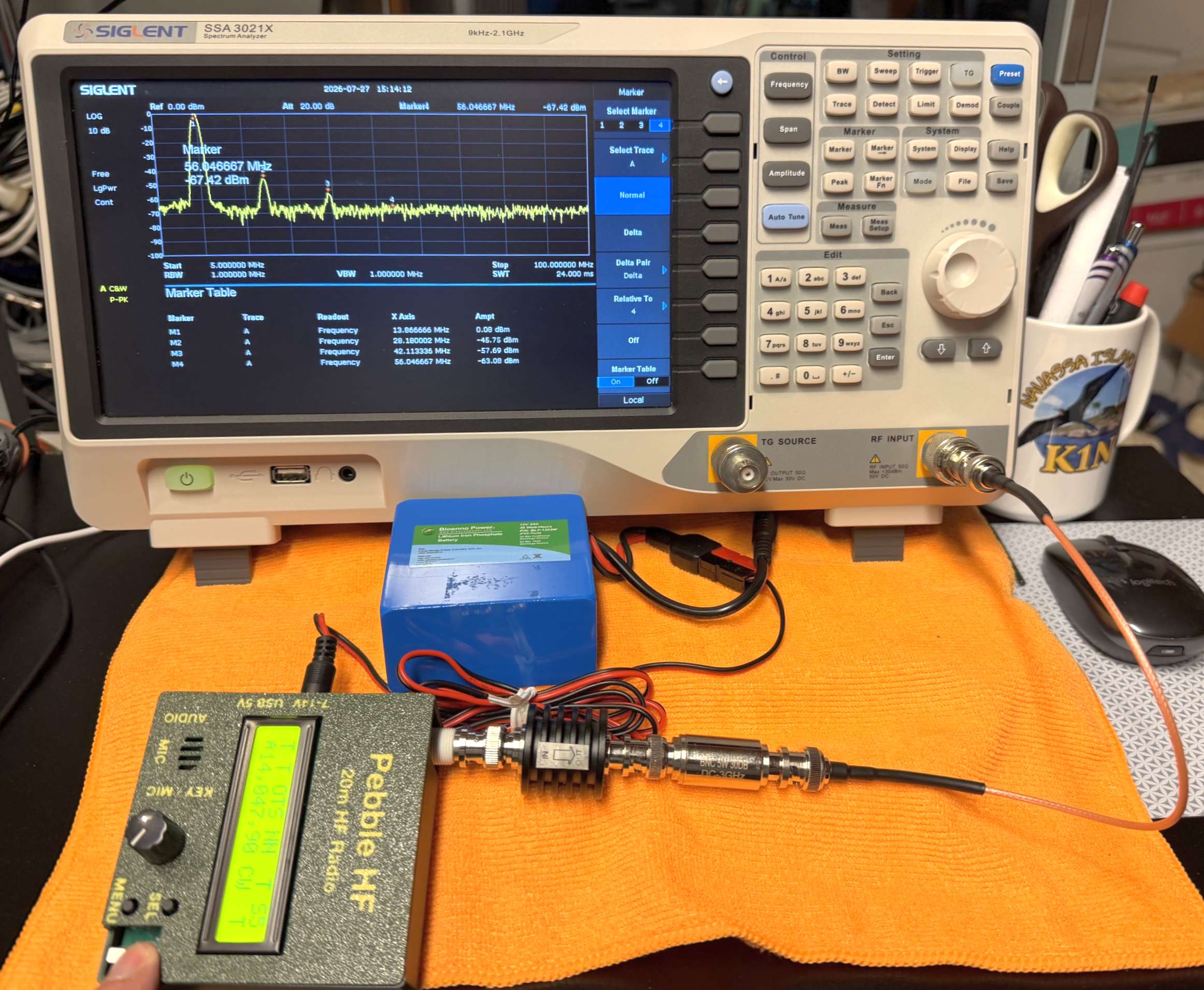
Next I set four markers for the primary and harmonics. This is what the analyzer reported:
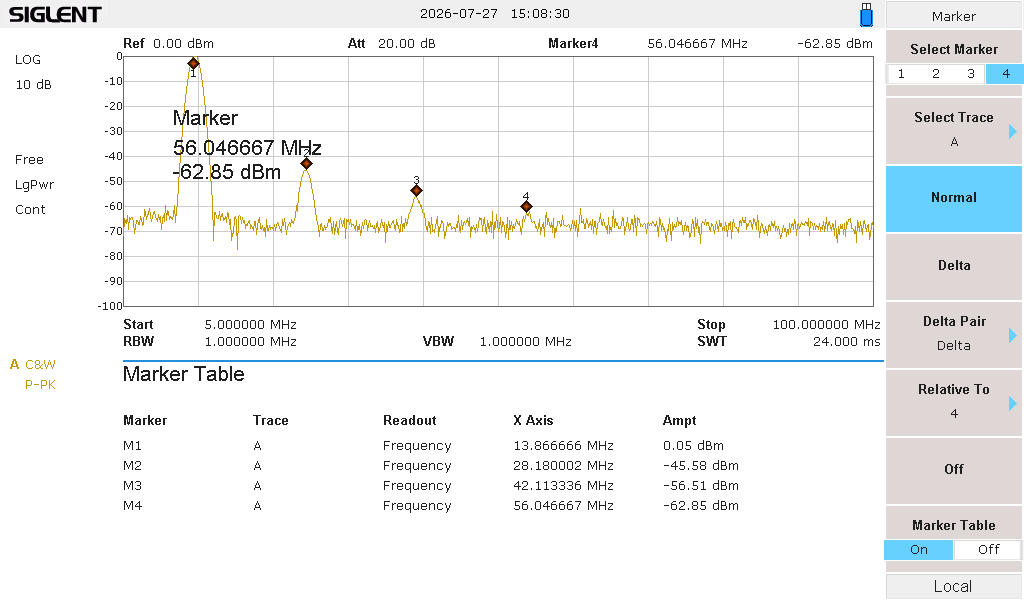
The table shows the 14 MHz carrier was at 0 dB, then the second harmonic was -45.6 dB below that. The 3rd harmonic was -56.5 dB and the 4th harmonic was at -62 dB.
FCC rule 97.307(d) says “For transmitters installed after January 1, 2003, the mean power of any spurious emission from a station transmitter or external RF power amplifier transmitting on a frequency below 30 MHz must be at least 43 dB below the mean power of the fundamental emission.”
The Pebble passes at -45.6 dB.