Has Solar Cycle 25 begun?

From SpaceWeather.com

Over the weekend, a magnetically reversed sunspot appeared in the sun’s northern hemisphere. Its high latitude and “backwards” magnetic polarity mark it as a member of the next solar cycle. Is Solar Minimum over? Not even close, but this development does suggest that Solar Cycle 25 is stirring.

From earthobservatory.nasa.gov:

Sunspot forecasters can distinguish old and new cycles by looking at two features of sunspots. The first feature is latitude. The first sunspots of a new cycle initially appear at high latitudes. As the cycle progresses, they begin appearing progressively closer to the solar equator. The second feature is polarity. Like the Earth, the Sun has a magnetic field, but the Sun’s field flips much more frequently than the Earth’s—usually at the peak of each sunspot cycle. The rapid flipping of the Sun’s magnetic pole affects the polarity of sunspots, helping scientists distinguish between sunspots belonging to different solar cycles.

Posted in Solar Cycles | Leave a comment

Mobile ZumSpot

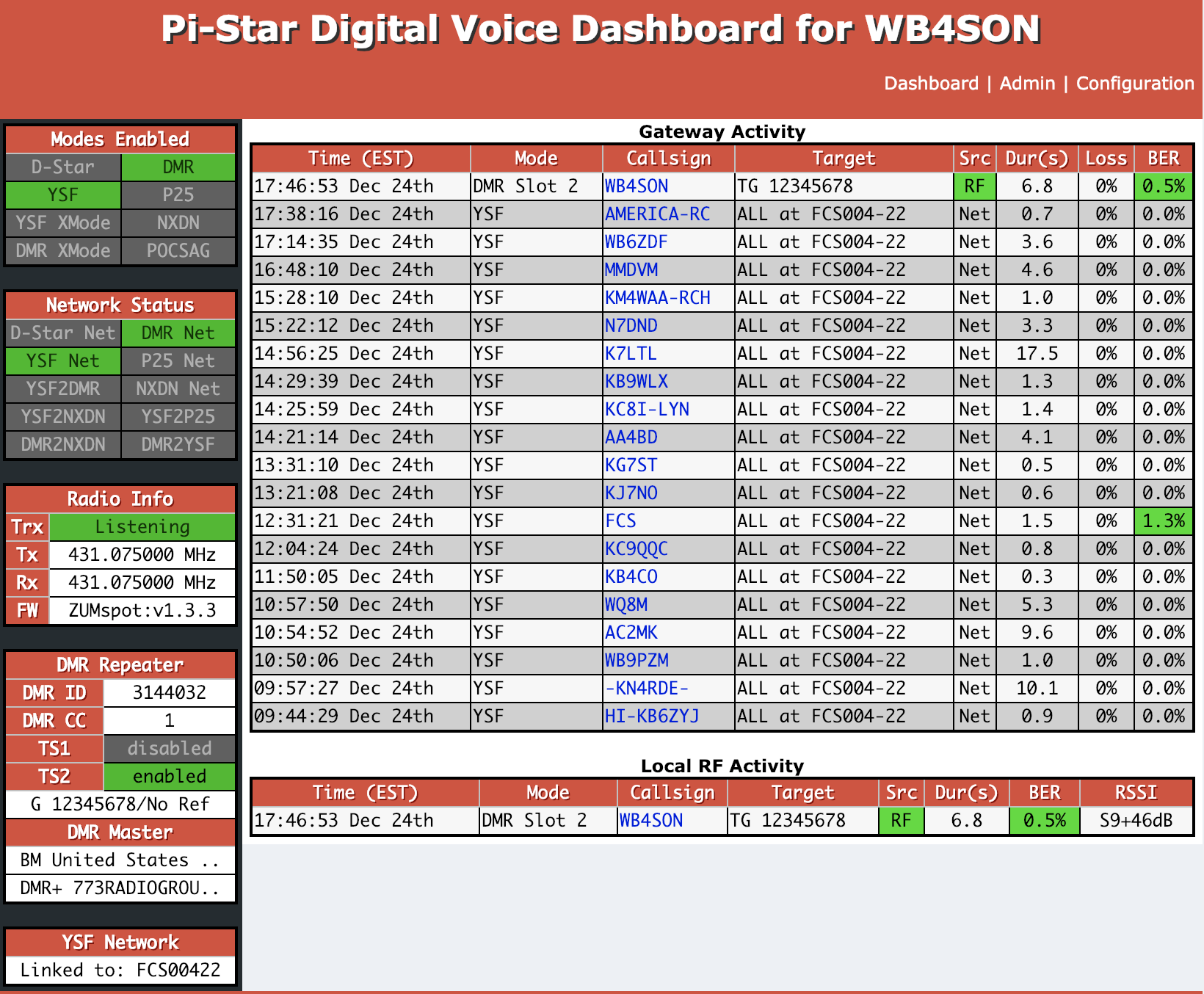
I’ve been using my ZumSpot on my home WiFi network for a few months.  I’ve heard several folks use their’s with their cell phone internet connection (Hotspot), and started to mess with that a couple of weeks ago.  It didn’t work the first time, it connected to my iPhone WiFi, but didn’t seem to be working.

Today I did a firmware upgrade and update cycle before trying it again, and it seemed to work perfectly.

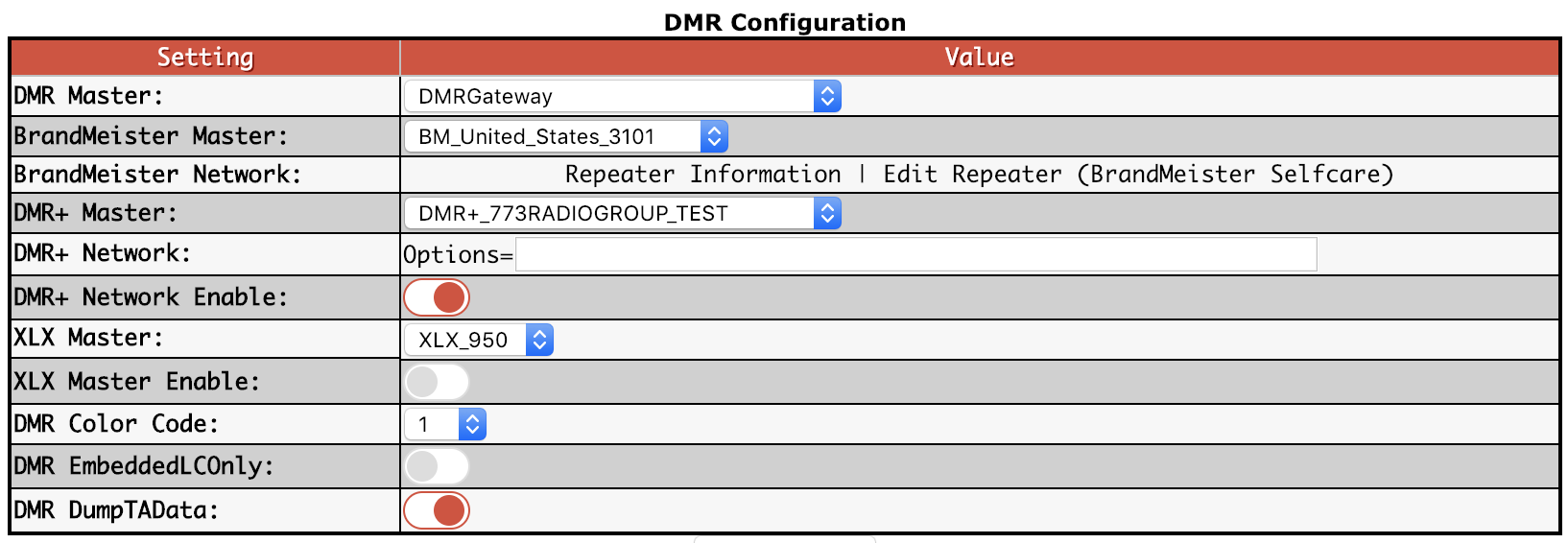
To add your phone Hotspot to your ZumSpot, go to your pi-star address on your browser and select the “Configuration” tab.  Scroll down the page until you find the “Wireless Configuration” section and select the “Configure WiFi” button.  Turn your cell phone Hotspot on, and wait for its SSID to show up, then select it and enter the Hotspot password.  Once this is done your ZumSpot should be configured to connect to whichever network it finds (home WiFi or phone Hotspot).

Posted in DMR, YSF, ZumSpot | 6 Comments

6-meters: The Magic Band

I usually do a bit of 6-meters operation during the spring and early summer for chance openings, but I’m not a 6-meter OP by any stretch of the imagination.

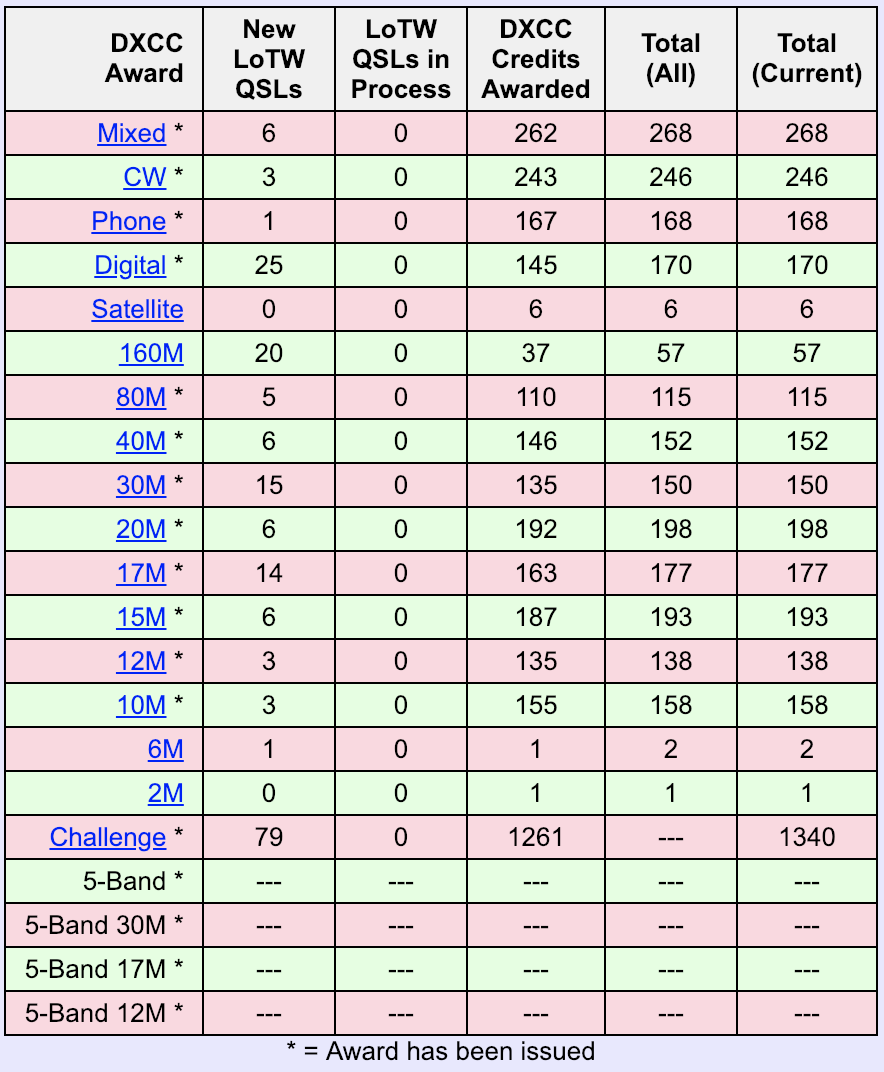
I was checking my LotW account this morning to see where things stand (goal wise) and I noticed a confirmation had come in from XE2JS in Mexico on the 6-meter band.  Just shows how magical that band can be (even in July).  Funny that I have only the US and Mexico now (only have 23 states confirmed).  I know I’ve worked a number of stations in the Caribbean.

Posted in 6-Meters, DX | Leave a comment

First JS8Call QSO

I’ve been reading the email about the new JS8Call keyboard QSO mode.  If you think FT8 but allowing free-text messaging, you’ve got the basic idea.  The exchange rate isn’t very fast, equivalent to 10-15 WPM CW, but it has similar heavy forward error correction as does FT8.

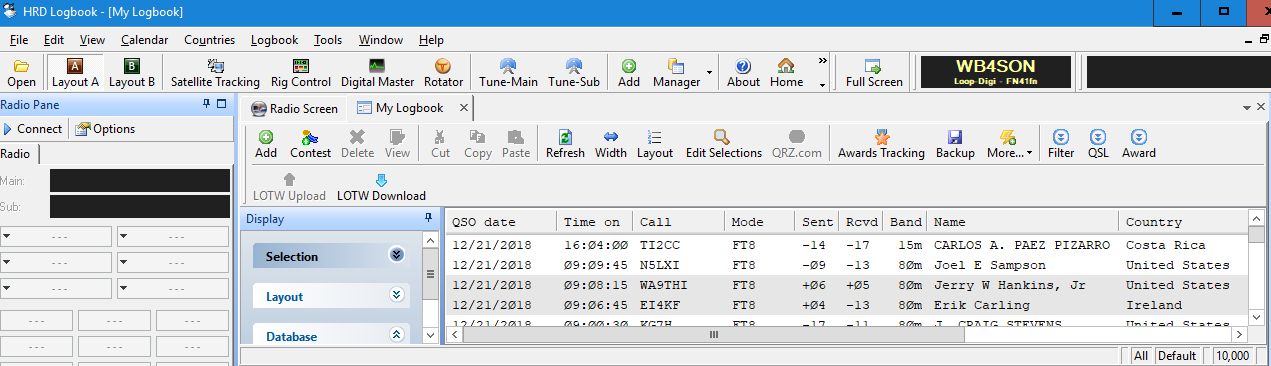
What you type is broken up into small chunks and sent out, then reassembled by the software.  See the middle of the screen where you can see W8VYM’s final transmission, which took about 5 blocks of 15 second.

I found the software very easy to install, and the setup and use quite intuitive.  I was on the air within a couple of minutes of downloading the program.

My condolences go out to John, WBVYM, in Eastman, GA for putting up with my fumbling during my first on-air QSO.

To obtain the software you must sign-up for the JS8Call group on groups.io (https://groups.io/g/js8call).

Because the software is in beta release, versions automatically expire.  The current version, 0.8.3, expires this Thursday, so a newer release will be out before then.

Thanks to Jordan, KN4CRD, for this fascinating new mode!

Posted in Digital Mode, JS8Call | Leave a comment

Thank you VP6D team!

I have to admit that hunting for VP6D felt like hunting real DX, a feeling that is pretty rare down here at the bottom of the solar cycle.  I had fun working them on 8 CW bands from 80-10m, plus SSB and FT8.  This isn’t the first time I’ve worked a team sailing on the Braveheart, and like those earlier events it was populated with excellent operators (14 of them), great pilot stations (8 of those).  Dave, K3EL, does an excellent job leading things as always.  Hard to imagine that they finished with 121,136 QSOs.  Even harder to imagine is that there were almost as many digital contacts (mostly FT8) as SSB contacts.  But of course CW continues to shine.  (56% CW, 24% SSB, 20% Digital)

My hat’s off to all the Ops, Pilot Stations, and the crew of the Braveheart for  another fantastic DXpedition.  I anxiously await all the behind the scene stories sure to come out over the next few months.

Lucky Gary KB7QFE, immortalized for being the last station recorded in the DXA app to work VP6D!

Posted in DX | Leave a comment

All likely bands completed with VP6D

This morning I picked up VP6D on 30 and 40 meter CW.  While the 30 meter contact came up on DXA quickly, the 40 meter contact took a very long time.  I had read that they were having some network issues out to the CW tent, which is a a kilometer away from the main station.  Anyway, the important thing is it showed up.  Hats off to the CW op.  I was just hearing them above the noise floor, and he caught the tail end of my call sending “SON SON SON?” several times until he dug out the whole thing.

I think folks generally feel like they accomplished something with their gear and skills.  But I know for sure the actual skill lies on the far end of the contact, with the OP dealing with pileups and fatigue.  Thank you VP6D!

Also pretty cool to see over 104K Qs in the log.  Who says you can’t have good DX at the bottom of a solar cycle.  57% CW, 26% SSB, and 17% Digital.  I suspect most of the digital contacts will be FT8.

By the way, the LotW confirmations show up quickly.  Thank you again.

Posted in DX, FT8 | Leave a comment

Sure enough – VP6D FT8 QSOs in log

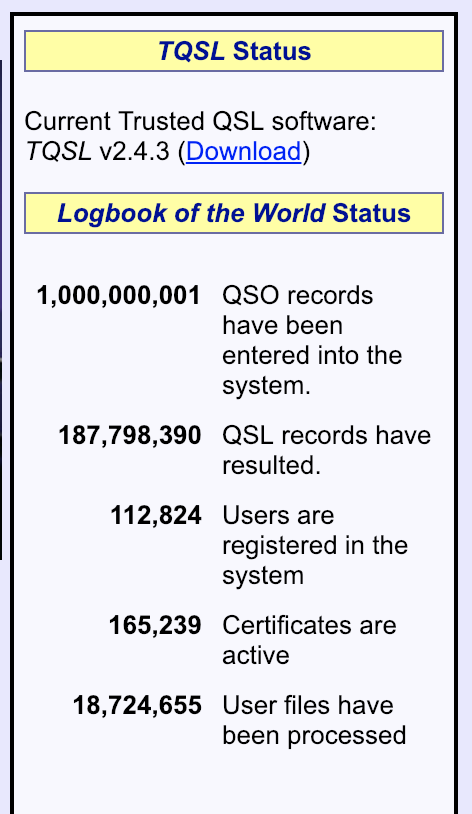
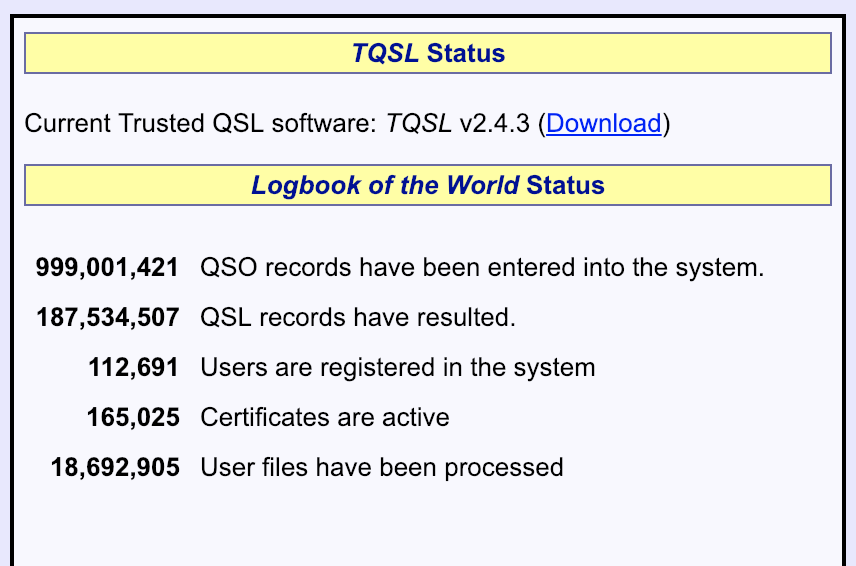
As I mentioned the other day, there appears to be an issue with the DXA.com application failing to show FT8 QSOs as they occur.  I made two the other day, and neither showed up on DXA, but they did show up in the actual log today.  Even with this minor glitch, the DXA application is a fantastic piece of work.

FT8 QSOs don’t show up on DXA

Actual logbook shows FT8 QSOs


Posted in DX, FT8 | Leave a comment

Success with FT8 for VP6D

Yesterday I had four bands on CW plus a SSB contact, so I needed a Digital contact have Ducie Island on all three modes.  VP6D was on 15-meter FT8 today and I worked them around 18:38 UTC.  I hadn’t run the Fox/Hound mode, but it was easy to add 21.091 to the list of Working Frequencies under Files/Settings/Frequencies, then use the File/Settings/Advanced tab to select the FT8 DXpedition mode “Hound” box.

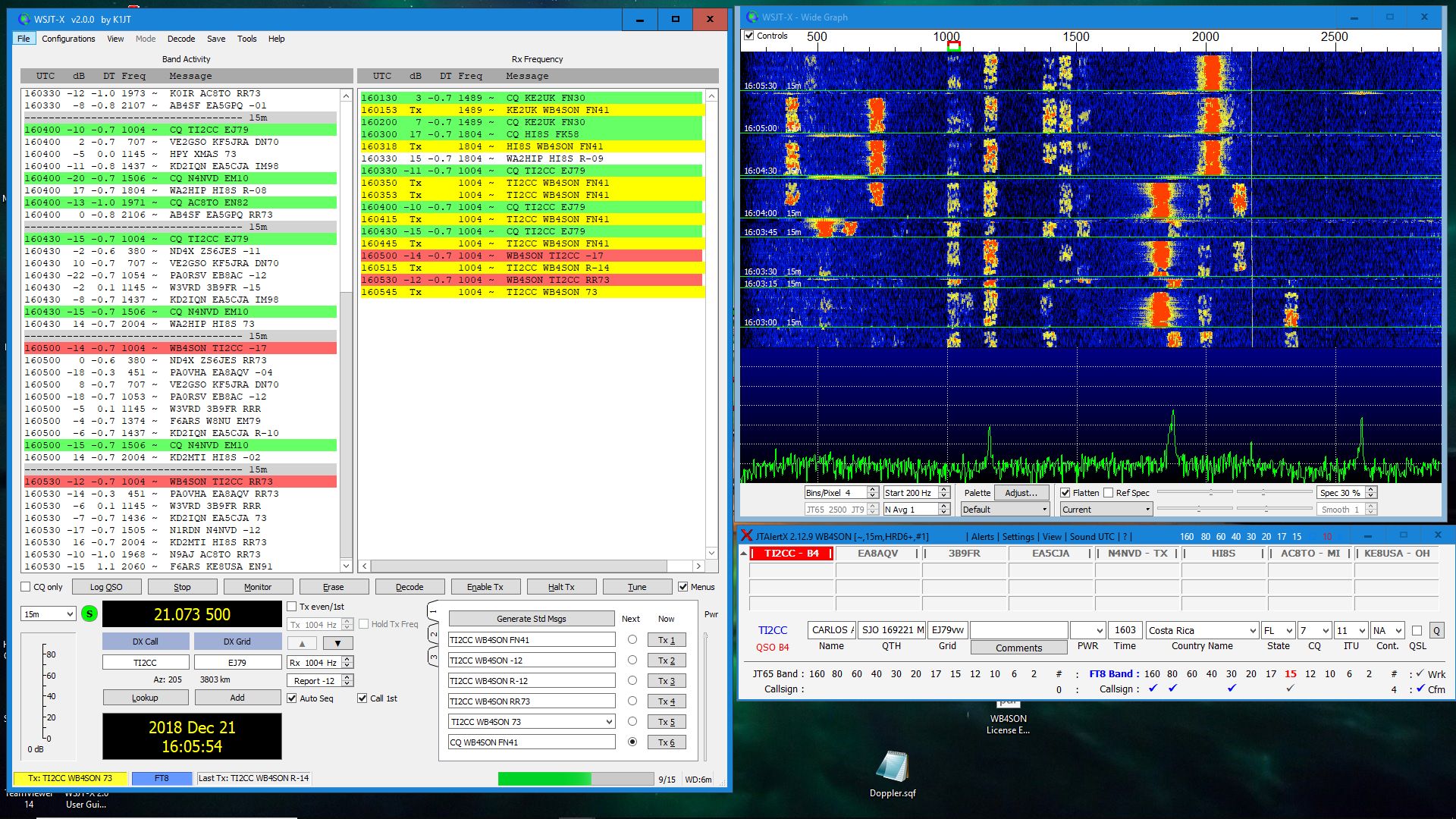
Watching FT8 working in Fox/Hound mode is fascinating.  The Fox will broadcast multiple signals around a 1000 Hz offset.  You can see VP6D sending six messages every time in the screen cap below (Circled area).  The hounds are all sending at any frequency they select above the Fox.  In my case I was sending at an offset of 1605 Hz.

You can see in the screen cap below that at 18:38:15 I had sent another call to “VP6D WB4SON FN41”, still on my original offset of 1605 Hz.  The next 15 second block is VP6D responding to me at 18:38:30 on offset 995 Hz. From that point on, my FT8 frequency automatically changes to that offset. and stays there until I receive my 73 at 18:40:00.  Pretty cool!

By the way, FT8 users should not panic if they don’t see their call show up int he DXA Real Time display.  VP6D folks have said there is an issue with that and to wait a day to see the calls show up in the actual log.

Posted in DX, FT8 | Leave a comment

VP6D Ducie Island

I’ve been a bit under the weather, plus my inverted-L had blown down in a recent storm, so I haven’t had much on-air activity.  My friend Willy W1LY came over a couple of days ago and got the antenna back in the air.  I finally made it to the shack in the basement this afternoon, and started hunting for VP6D, Ducie Island, an all-time new one (ATNO) for me.

I was lucky enough to work them on 17, 15, 12, and 10 meter CW, as the signals from VK land are just booming in this afternoon.  The operators on Ducie are amazingly skilled too.  But the team use of DXA is simply fantastic, and allows one to confirm things right away.


Posted in DX | Leave a comment

Nice day with Scouts working satellites during JOTA

Today was the sixth JOTA (Jamboree On The Air) that I’ve had the privilege of working at, along with other Newport County Radio Club members.  While the weather was dicy yesterday (poor scouts trying to sleep during some rather strong wind/rain storms), when I showed up around 10:30 this morning, there was nothing left but fluffy clouds.  Rob KC1ZZU and Willy W1LY, helped me to setup my satellite station shown in the photos below.  By noon we were on the air and worked about 30 stations during multiple passes of AO7, SO50, AO91, AO92, and CAS4B over the next five hours.  By 5 PM, with Willy & Rob’s help, the gear was stowed in my truck and I was headed home.  Jim KA1ZOU and his crew worked very hard and a large number of scouts obtained their Radio Merit Badge by the time the day drew to a close.

The RF end of the station: Icom IC910H, Portable Rotation AZ/EL controller, Toughbook running SATPC32

Antenna Magic — Arrow “Alaskan” Antenna mounted on two beams for 70cm and 2m vertical, with Portable Rotation AZ/EL rotor, mounted on a Pyle speaker stand.

The equipment in use is a fairly old Icon IC-910H (2m/70cm multimode radio), and a Panasonic Toughbook removed from police service running SATPC32.  The computer handles the Doppler corrections for the radio uplink and downlink, as well as tracking data for the antenna system.  A PortableRotation.com AZ/EL Rotor is used to steer two halves of an Arrow Antenna “Alaskan” antenna (one Alaskan antenna plus another boom — the antennas mounted vertically on each side of the rotor’s boom).  A 30 AH LiFePO4 BioennoPower battery provided the power for the radio and rotor.  The system worked flawlessly for ten satellite passes over 5 hours (the LiFePO4 battery had used about 1/4 of its capacity, and the laptop battery still had another hour left in it).

The antennas worked well from horizon to horizon and provide some rather long DX into the UK, Caribbean, and South America.  There were some very deep fades due to the simple vertical polarization on my end, but overall signal levels were excellent.  CAS4B in particular was quite lonely.  But AO7, launched 44 years ago in 1974 was VERY busy and stayed in Mode UV all day long.


Posted in AMSAT, AO-7, AO-91, AO-92, CAS-4B, IOTA, Satellite, SO-50 | 4 Comments