
With all our antenna experiments, our solid-state transceivers can be pushed to the limit. This is especially true for many QRP rigs, which don’t have internal antenna tuners, and sometimes even lack SWR protection circuits. An example of this would be the original QCX transceiver. If you forgot to attach an antenna, or fed it into some inhospitable load, it would promptly emit magic-smoke as the final amplifier bid you farewell.
Things improved a bit when SWR detection circuits were put in to QRP rigs. The good news was the finals were protected. The bad news was they often shut down the transmitter completely, requiring a power-cycle to restore operation. This meant that external antenna tuners couldn’t be used as there was no RF to drive them.
There is a very simple solution to these issues, and some QRP tuners have implemented it in the form of a TUNE vs. OPERATE switch. The tuner simply switches in an attenuator when in the TUNE position. The output end of the attenuator still provides enough power to allow the tuner to be adjusted.
A 6dB attenuator guarantees that the worst case SWR seen by the transmitter is no more than 1.67:1, well under the 2:1 range that starts to cause transmitter issues. Short the output of the attenuator, or leave it open, and the SWR will never exceed 1.67:1.
Since a 5 watt QRP rig will still produce more than a watt of power at the output of the attenuator, one could use a 6dB attenuator with ANY antenna. That might be ideal for use with a multiband WSPR transmitter – allowing instantaneous band changes.
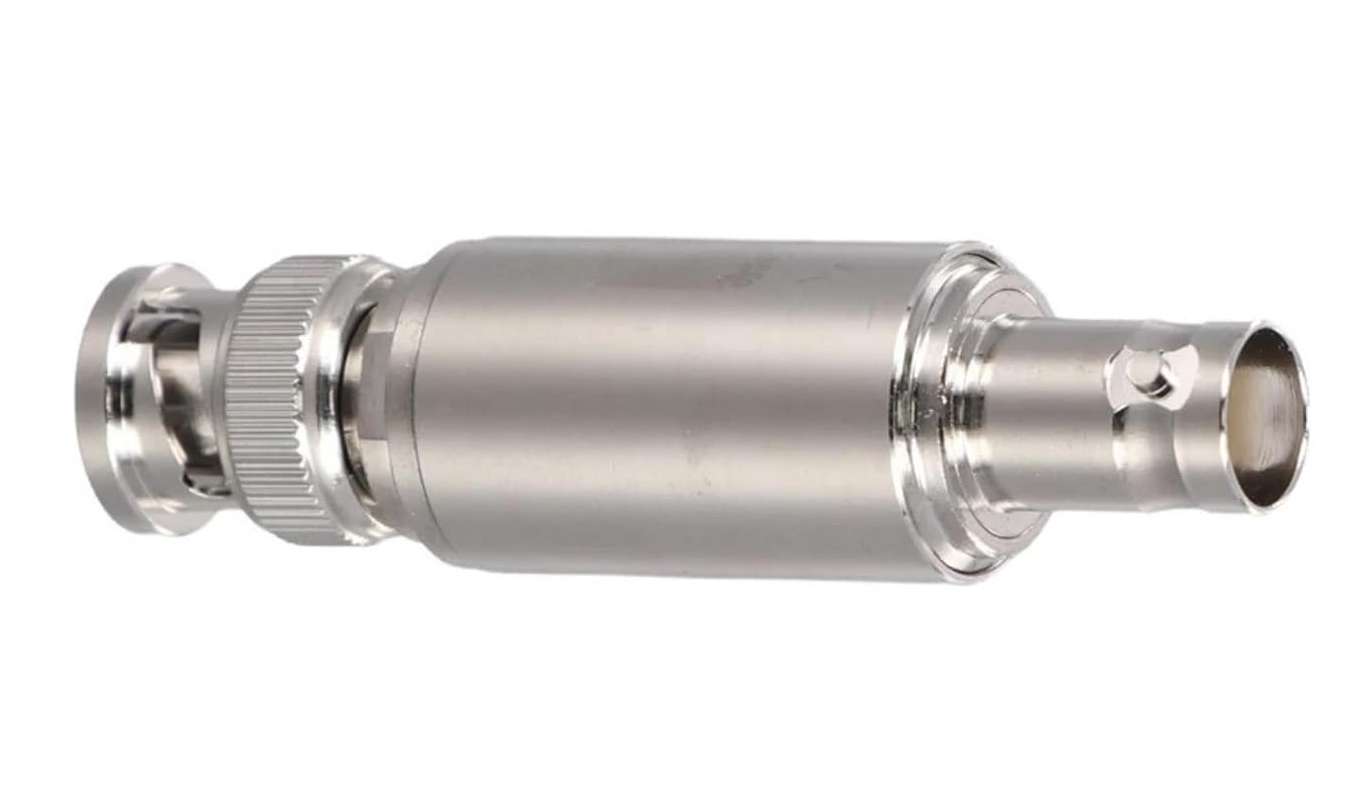
An example of such an attenuator, rated at 5 watts and costing about $15, is shown below







Pingback: Amateur Radio Weekly – Issue 427 • AmateurRadio.com