After building a QMX and QMX+, I decided to order another QMX for 20/17/15/12/10 meters, factory assembled. Given high demand, it took about 6 months to build, and recently arrived. I was a bit surprised since it arrived after all the tariff ping-pong.
I hit a few snags getting it on the air – the first being that it appears to have been configured from the wrong bands (80-20). It took a bit of looking to find out how to change that (factory reset, then select the proper band configuration). After that it appeared to work fine, but I need to verify internally that it was actually BUILT for the 20-10 configuration.
My next issue had to do with the microphone I had ordered a year ago from the UK. It was supposed to be compatible with the QMX, but I discovered that tip and ring had been reversed internally (you can see a Rube Goldberg contraption on the left side of the radio to reverse tip/ring). The mic came from G7ufo.radio, and costs $57 shipped to the US including shipping and tariffs.
Oddly enough, while testing the radio, I saw a “S” appear next to the battery display (which by default is OFF). That meant the radio was shutting down transmit due to high SWR, which was odd given it was transmitting into a 50 ohm dummy load. But sure enough, I discovered that the dummy load was indeed defective – I could wiggle the center conductor and get either 50 ohms or infinity). So I switched to a dummy load that actually worked.
As a bit more margin, I hooked up a 9.6 volt battery (the unit was built for 12.0 volts), and fired it up on the 10-meter band. Sure enough, a USB signal came out. I discovered the mic was somewhat hot and if I spoke loudly a “G” appeared on the display (indicating the audio input was too high).
The audio appeared clear and of the appropriate bandwidth. Pretty cool to have a 5-watt QRP SSB radio for a $140 kit (including shipping and enclosure).
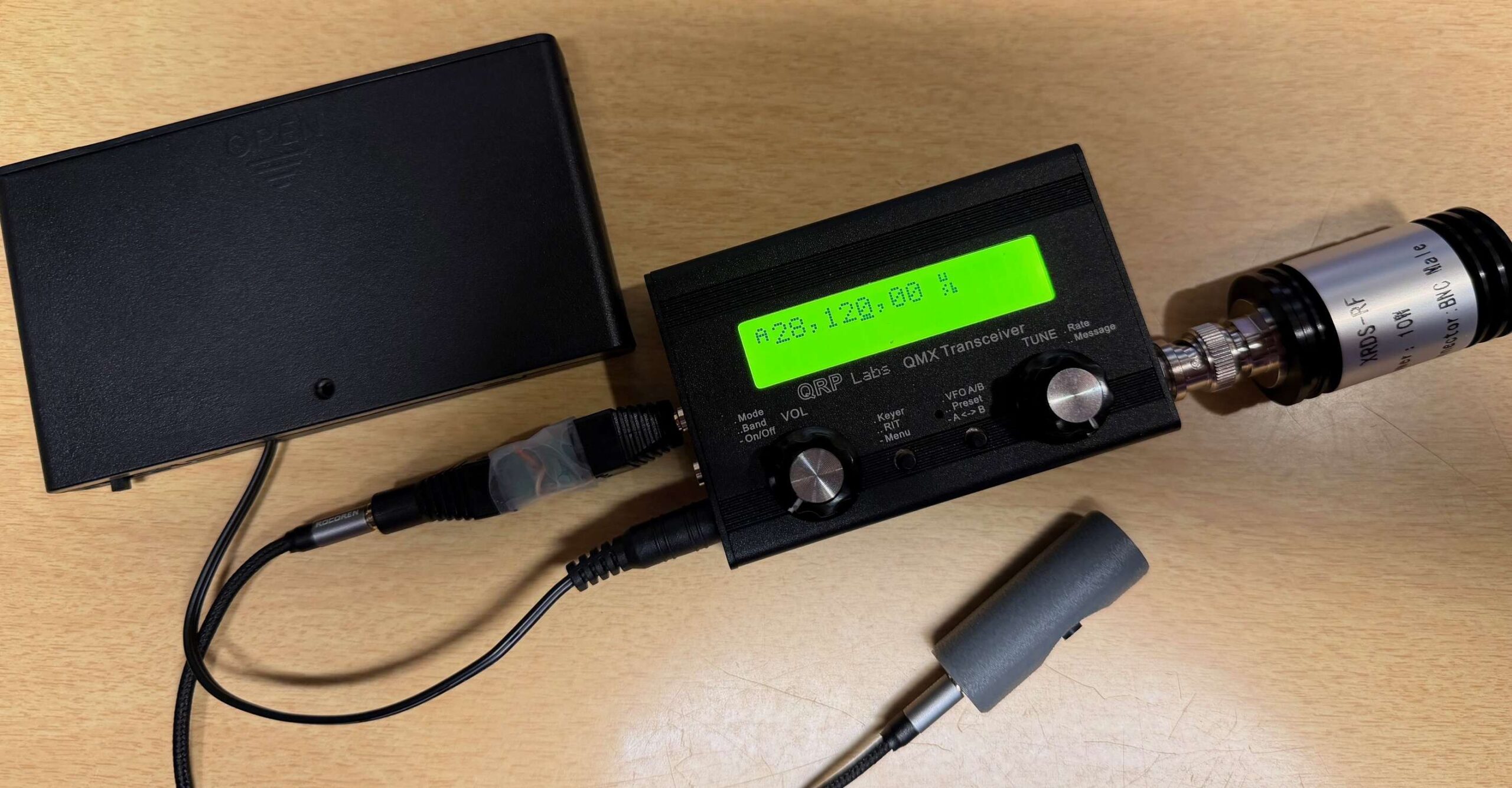
QPRLabs QMX transceiver operating USB into a dummy load (right side), running off a 9.6 volt battery (upper left), with a kludged adapter to reverse Tip & Ring (left middle). The G7UFO mic can be seen on the bottom